A Growing Up
A Memoir of Marriage, Addiction, Betrayal, and Letting Go

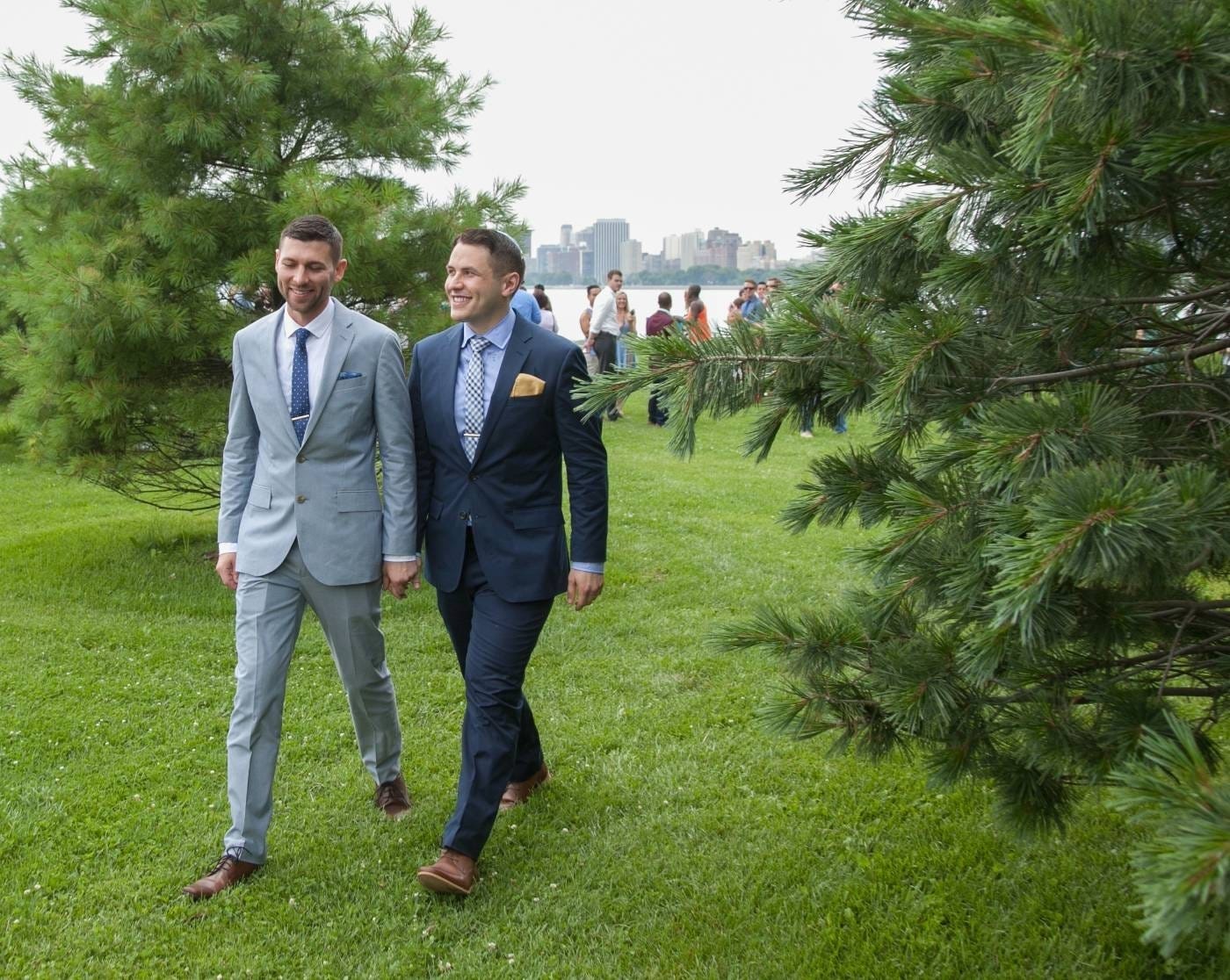
With my husband, Nate, on our wedding day in Chicago, IL, on July 19, 2015
“Love does not begin and end the way we seem to think it does. Love is a battle, love is a war; love is a growing up.”
― James Baldwin
This essay is a personal memoir about loving and losing my husband after seventeen years together — through addiction, betrayal, and the slow collapse of a marriage I believed would last forever. It explores the psychological toll of abandonment, divorce, and trauma — and the long, uneven process of rebuilding safety and meaning afterward.
As a writer, filmmaker, and musician, this piece accompanies my poetry collection, The Love You Left Behind, and my first EP, The Shape of Missing. I’m sharing this essay for anyone who has survived loving someone who didn’t stay — and is trying to gently heal, and grow up, in the aftermath.
Eternal Sunshine
I met my future husband, Nathan Johnson— who I would always call Nate — on a Friday night in November 2008, when I was twenty-four years old.
I had come out as gay just a year earlier, after years of quiet struggle to accept myself. At North Carolina State University, I poured my heart into animal activism and vegan advocacy — believing deeply that compassion shouldn’t stop at the human species. As a vegan, gay, Jewish Yankee from New Jersey and New York City who knew no one in North Carolina, that conviction wasn’t always welcome. I received death threats for speaking out about animal protection, which only deepened my sense of isolation.
So I threw myself into purpose. During my freshman year at N.C. State, I started an animal rights organization, joined the Student Senate, marched against the Iraq War, spoke out for equality, led campus campaigns, organized rallies, volunteered anywhere I could make a difference. My life became an act of service — a desperate, determined attempt to prove that love and empathy could change something, even if they couldn’t yet change me.
Those efforts took me across the world. During college, I joined veterinary service projects in the Galápagos Islands and rural India, studied wildlife sciences in Kenya one summer and Botswana for a semester, and delivered my college graduation speech before ten thousand people about serving the “global good.” For all that outward motion, though, something inside me still felt unsettled — like I was running toward meaning but hadn’t yet found home.
After graduation, I enrolled in a small graduate program at Tufts University, thinking I’d become a veterinarian. But the program was tiny, and I felt alone again — adrift among people who didn’t quite understand my restless heart. So I pivoted, deciding to pursue law instead — but not before volunteering for, and then working on, Senator Barack Obama’s first presidential campaign from 2007 to 2008. I wanted to protect what I loved, to fight for justice in a broader sense, and to — in the Jewish tradition — practice tikkun olam, repairing the world.
By the time I met Nate, I was still figuring out who I was and where I belonged. Vegan since fourteen and raised by a single mother, I’d always believed in leaving the world better than I found it — but that path had been lonely and uncertain. My mom, to her credit, had gently encouraged me to be honest about who I was, even before I could say the words out loud. So the idea of meeting someone who saw me fully — who understood both my convictions and my contradictions — felt almost impossible.
I’d heard about the 23-year-old named Nate weeks earlier, when my friend Scott asked which potential roommate to choose. I picked the cute Michigander moving to Boston for medical school after graduating from Michigan State. “You’ll like him,” Scott said — and he was right.
Days before meeting him, I had returned from a whirlwind, life-altering experience: helping elect Barack Obama as the 44th President of the United States. I’d joined the campaign as a doe-eyed recent grad searching for meaning and impact, eventually hired as a field organizer. For a few hundred dollars a month, my entire life changed.
So coming home to meet a cute guy might have seemed small after having a hand in making history. But when I saw Nate — sea-blue eyes shimmering as he sat on a couch among friends — I felt the quiet click of fate.
I’ve never believed in love at first sight. I still don’t know that I do. I only know that something felt different between us. There was a light, almost instinctual ease — a simplicity that felt destined to continue. And destined it was: the connection that began on a chilly November night grew into a deep love and an apparently unbreakable bond for the next fifteen years.
Our first night was typical: a dance floor, a late-night diner, a hookup. The years that followed were not. They felt kinetic, exciting — cinematic even. We had a whirlwind of adventures: rescued dogs, realizations, relocations from Boston to Chicago to Los Angeles. Sunny afternoons, rainy mornings, and, later, a tragic end that — for now — eclipses the beginning with its startling terror and breathtaking uncertainty.
But in those early years, before the unraveling, love felt simple.
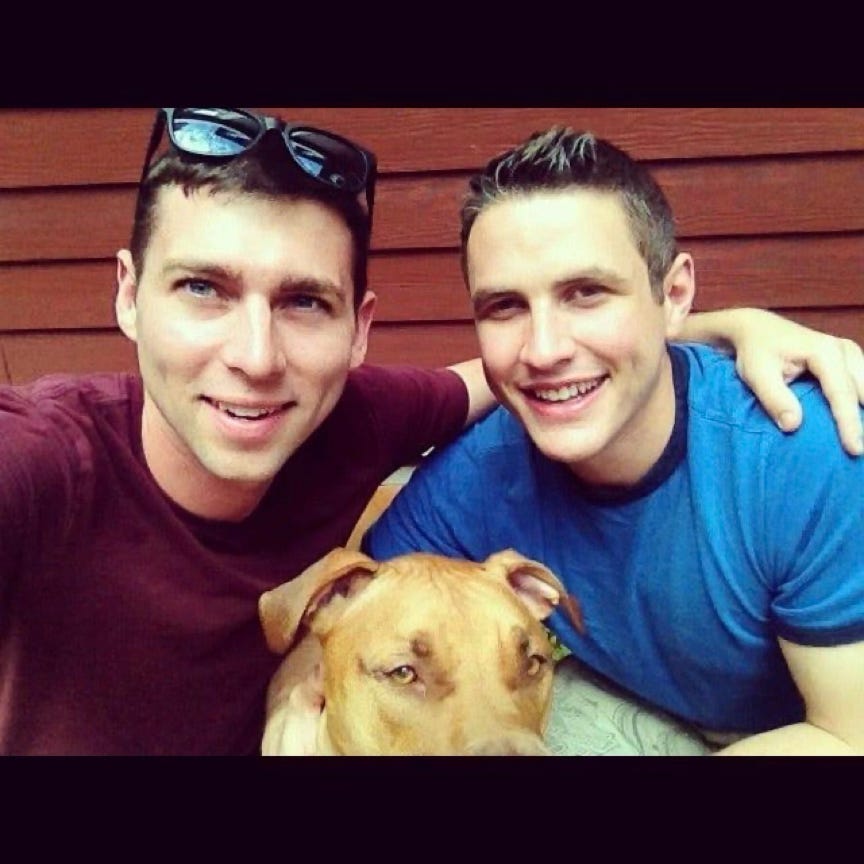
With Nate and our rescued dog, Cooper, in Jamaica Plain, MA, in July 2012. We found Cooper in February 2010 in Brookline, MA, as we were driving to see friends. A tan Rhodesian Ridgeback mix, he ran right in front of our car as we approached a traffic light. I pulled over, got out, picked Cooper up, and asked Nate to open the backdoor. We then called our friends and said they’d have to come over instead, because we “have a dog now.” We brought Cooper to an animal rescue group, where he lived for a few weeks, but the staff kept calling us to say that “your dog is waiting for you.” The rest is history — and we loved him immensely.
It felt like hope made tangible — like a long exhale after holding my breath for years. Even though I had dated a few men after coming out, Nate and I shared the kind of connection that made ordinary life shimmer. We stayed up until two in the morning talking about everything: politics, philosophy, animals, ethics, the future. We talked while I was in Israel just weeks after we met, went repeatedly to our favorite Tibetan restaurant near Boston and ordered the same meal every time; traveled to Florida to visit my mom, where a cashier once said we “looked like brothers;” drove fourteen hours to Michigan with our dog, Cooper, asleep in the backseat; organized events together for President Obama’s reelection campaign; rescued dogs together — even abroad; spent Thanksgivings with my father and half-siblings in New York; and, nearly every weekend, Nate took a long bus ride from Boston to Maine just to see me while I was working for a labor union.
In short, I felt seen in ways I never had before. I wasn’t the lonely activist anymore, or the kid fighting for compassion in a world that mocked it. I was someone’s person.
For the first time, I wasn’t just chasing purpose; I was building a life that felt like home.
And Nate was that home in human form.
With Both Eyes
by Jared Milrad
When I close my eyes
and rest my soul,
I see — like the clearest dawn —
you, as you were.
Choosing me.
Loving me.
Holding me
as one.
Because I was
imperfect
and because
we were worth it.
I can feel you still —
the steady beat
in your chest,
the breath
in your lungs
summoning me
home.
But then I awake.
My heart, torn in two.
My lungs, cut open.
And I see now —
with both eyes —
that you
are gone.
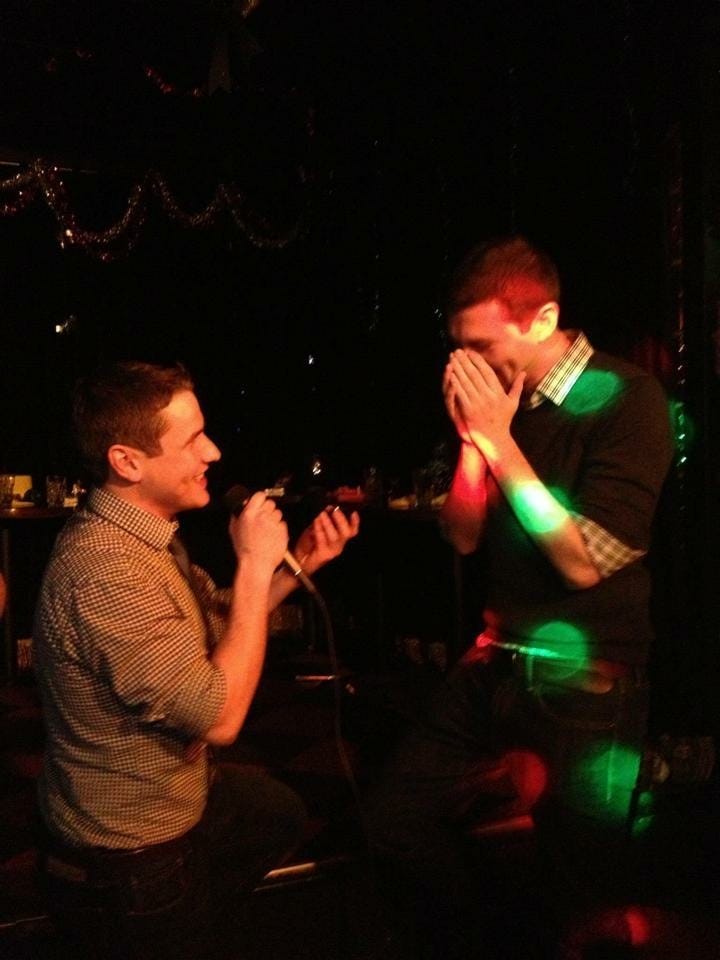
Proposing to Nate at the historic Stonewall Inn in New York City on December 31, 2012. He said, “You know the answer.” (We both agreed this meant “yes”.)
Love in Heavy, Humid Air
“Give your hearts, but not into each other’s keeping, for only the hand of life can contain your hearts.
And stand together, yet not too near together, for the pillars of the temple stand apart.
And the oak tree and the cypress grow not in each other’s shadow.”
— Khalil Gibran
After five years of dating, many ups and downs, and lots of adventures, I asked Nate to marry me at the Stonewall Inn — New Year’s Eve, 2012 — on a stage before midnight, in front of a very New York blend of friends and strangers. His answer — “You know the answer” — was all I needed. We kissed, danced to Bruno Mars’ “Just the Way You Are,” called our parents — and a man on the street promptly offered us cocaine to celebrate, just before we picked up 99-cent pizza. Manhattan.
Less than three years later, Chicago awoke to one of those classic summer days — hot, muggy, shirts sticking to skin. By the time we ran from our car to our improvised wedding venue — a public patch of grass near Lake Michigan at Montrose Harbor — sweat already seeped through our suits. As usual, we were late, jogging past the boats with a chaotic smorgasbord of wedding supplies.
We’d decided not to bring our rescued Rhodesian Ridgeback–pit mix, Cooper. He’d make a cute ring bearer, but he had a history with men he didn’t like (an ironic twist for a dog adopted by two gay men). Even though Nate wasn’t Jewish (we later learned he’s likely a quarter Sephardic), we chose a Reform Jewish ceremony, performed by a rabbi from the local Reform synagogue. Nate’s dad put last-minute touches on the chuppah — a word he never quite pronounced right. Weeks earlier, we’d driven with Nate’s dad and younger brother to central Michigan to find the lumber.
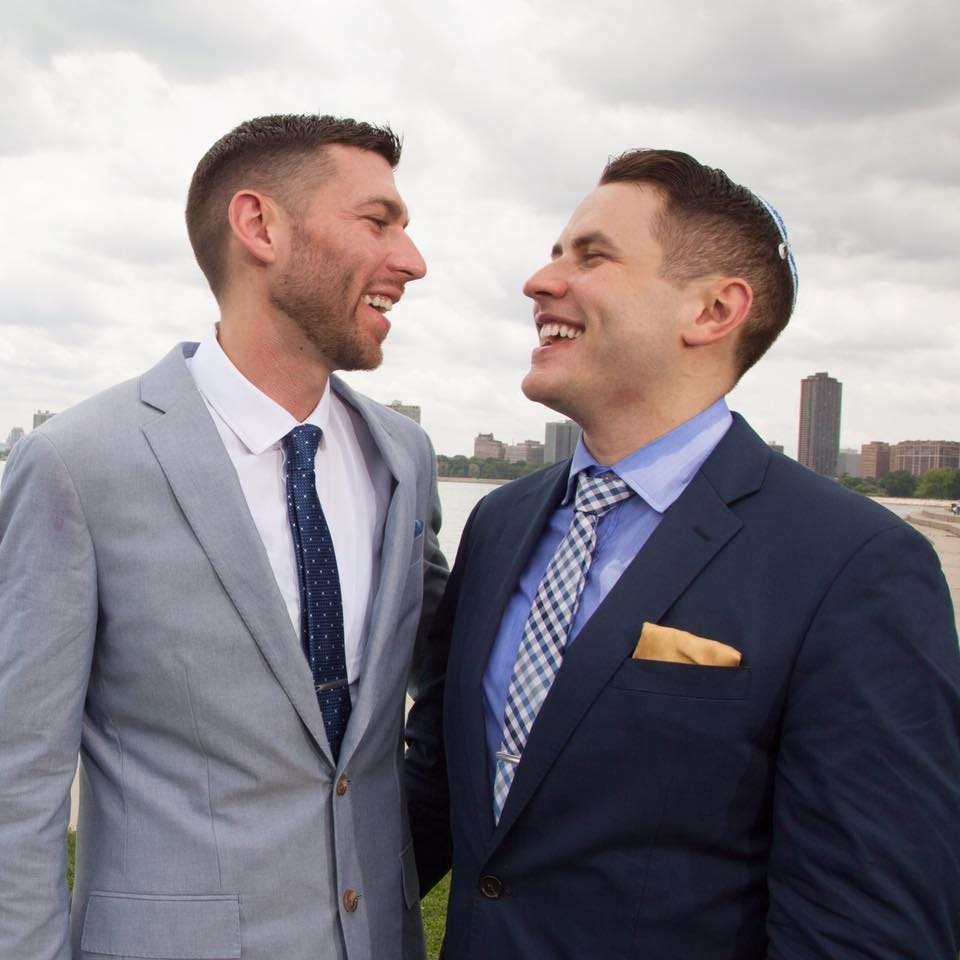
With Nate on our wedding day in Chicago, IL, on July 15, 2015. It was hot and humid (sweat poured through our shirts), and even though we improvised the entire thing (like much of our relationship), it was a day I’ll never forget.
Not much else felt real about July 19, 2015. Just three weeks earlier, our wedding — a vegan Jewish New Yorker marrying a recently vegan atheist Michigander — would have been legally impossible in most of the country. Obergefell — the landmark U.S. Supreme Court case that made marriage equality the law of the land — changed that by a single vote. And we had just made a small kind of history ourselves, appearing (for five seconds, holding hands) in Secretary Hillary Clinton’s “Getting Started” video: “I’m getting married this summer to someone I really care about.” The media noticed. Russian outlets even slapped an 18+ warning on the clip because two men were holding hands.
The New York Times showed up at our wedding, as did local press. We filmed a short documentary — Jared and Nate: A Love Story. Even our rabbi called us “a sitcom setup,” given our different backgrounds (other than the obvious one we shared).
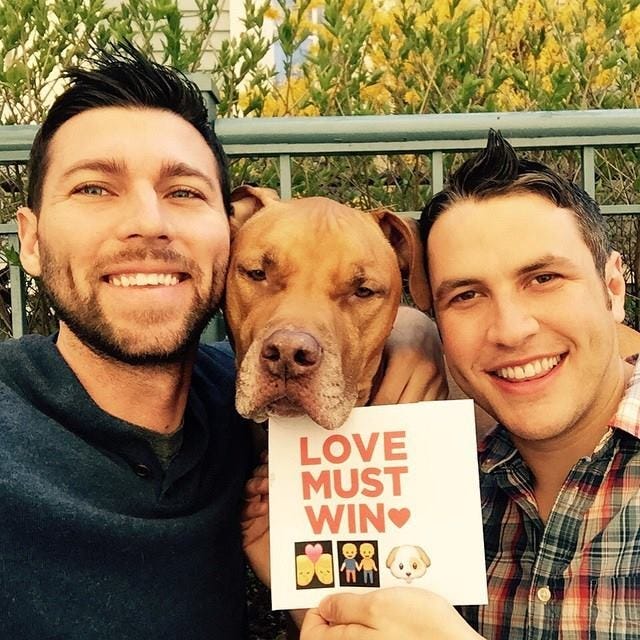
With our dog Cooper just before our wedding in Summer 2015 in Chicago, IL
Most of our wedding day is a blur, as wedding days often are. I remember Nate’s eyes during our vows and the line that undid me, as his voice cracked with emotion: “I had to have you.” I remember my mother’s face in the crowd, lit with a hope for grandkids. And I remember reading my vows to Nate, telling him how I would “love him until my last breath and beyond,” breaking glass in the Jewish tradition, and holding Nate’s hand as we walked away after the ceremony. And kissing him, of course.
Inside our rings we had engraved two words: Eternal Sunshine — a nod to Eternal Sunshine of the Spotless Mind. In the film, Joel (Jim Carrey) erases Clementine (Kate Winslet) from his memory; she does the same; they still find each other. For us, “Eternal Sunshine” meant the promise of limitless potential and the ability to forgive, heal, and build something stronger; it was also just a movie we loved. I didn’t know then how prophetic it would feel.
We drove to the LGBTQ Center on Halsted for the reception, bursting into the room to Lady Gaga and dancing through our entrance. My mother made the crowd laugh; Nate’s parents spoke; we thanked everyone for celebrating not only our wedding but a new national reality. I danced with Nate’s grandfather, who spun me around and made me laugh. We said late-night goodbyes over food, went out late with my mom, stepmom, and close friends, and finally reached our hotel just before sunrise — exhausted, happy, and facing a future that felt limitless.
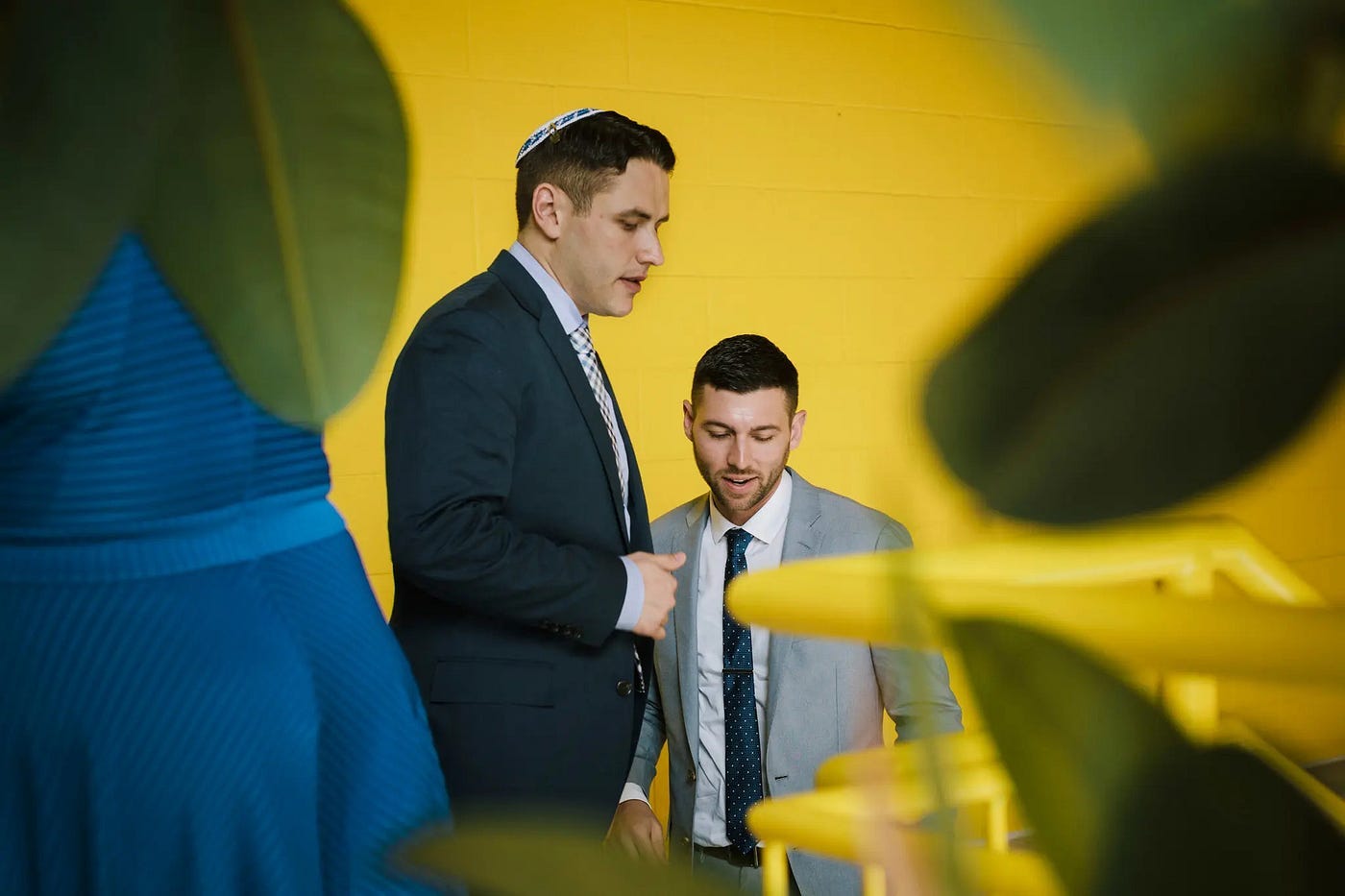
Entering our wedding reception at The LGBT Center in Chicago, IL, on our wedding day, July 15, 2015. Having The New York Times at our wedding was quite odd, but it made the day that much more special. We wore matching Converses and danced into a Lady Gaga song, as our friends and family cheered us on.
The Contours of Us
Before and after that day, our love remained fluid and fresh. We adventured — from Costa Rica to Japan to Uganda and Tanzania to Israel. We rescued strays in Boston, North Carolina, Cuba, and Colombia. We moved: Boston → New York → Michigan → Chicago → Southern California → Los Angeles. We chased National Parks — Yellowstone, Joshua Tree, the Channel Islands, Zion. We fought, we laughed, we rediscovered each other.
Adventure carries its own setbacks. On our wedding day, Nate had promised, “I’ll support you in all your future career choices — even if it’s being in a rock band or running for county drain commissioner.” He meant it. After grad school and law school, I veered — from public-interest law to starting a nonprofit, to journalism, to running for office, to delivering takeout for DoorDash just to survive, to launching a company and another nonprofit, to social-impact filmmaking, acting, writing. Through it all, Nate was there.
He was there in grief, too. Three months after our wedding, my father, Martin, died after a long fight with dementia. Nate knew him, laughed with him, loved him — and my dad loved him back. I delivered the eulogy, steps beside my father’s casket; afterward I cried on Nate’s shoulder harder than I’d ever cried before. I was so grateful for him then — and always.
We also lost two dogs who we had rescued and loved dearly. Cooper — our first, found on a Boston corner in 2010 — died suddenly in November 2017. Oliver, adopted the next month, died in October 2023 after a long battle with cancer.
The losses were profound. I don’t know if we ever recovered.
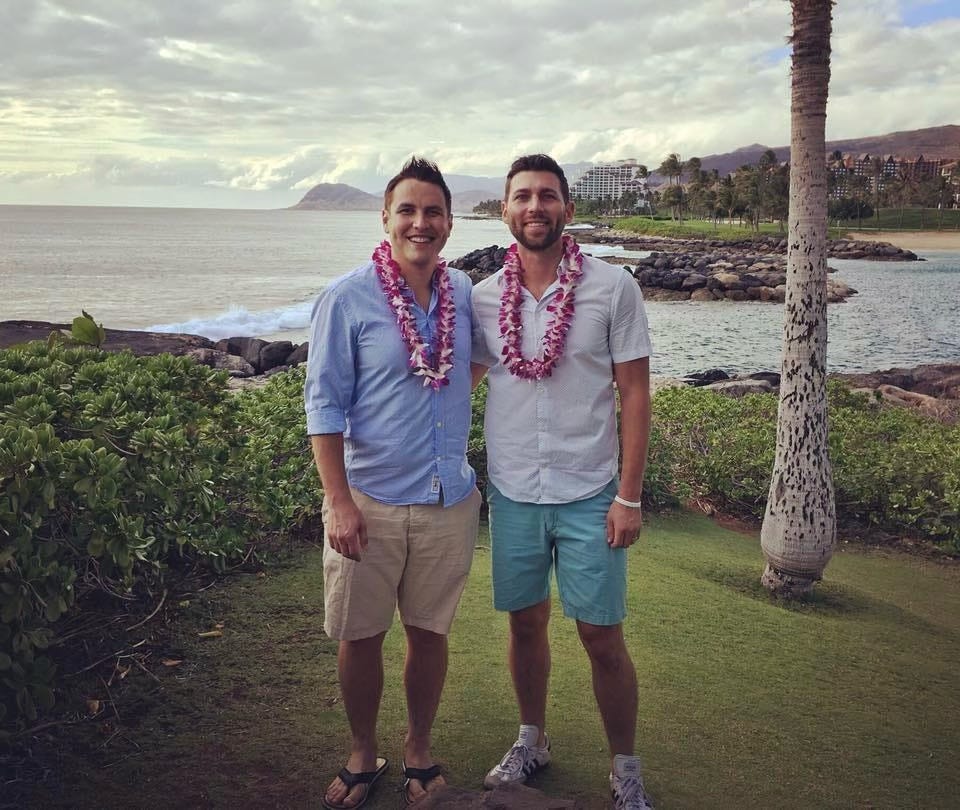
Renewing our vows together in Oahu, Hawaii during our honeymoon in 2016. On our honeymoon, Nate surprised me and had arranged for us to participate in a vow renewal ceremony. All of the other participants were married straight couples who had been married for decades — while we were only 8 months in. Either way, I felt grateful to be able to reaffirm my vows. I loved Nate more than anything.
If There Is An Afterlife
by Jared Milrad
If there is an afterlife,
will I meet you
as you were —
open-eyed, soft-palmed,
the weight of your love
still resting gently on my chest?
Or will you come
as you are —
fractured, distant,
a shadow wearing
the shape of someone
I once called home?
And if I meet both —
the one I chose
and the one who chose to leave —
will I still love you?
Or only the shadow
of you
who stayed?
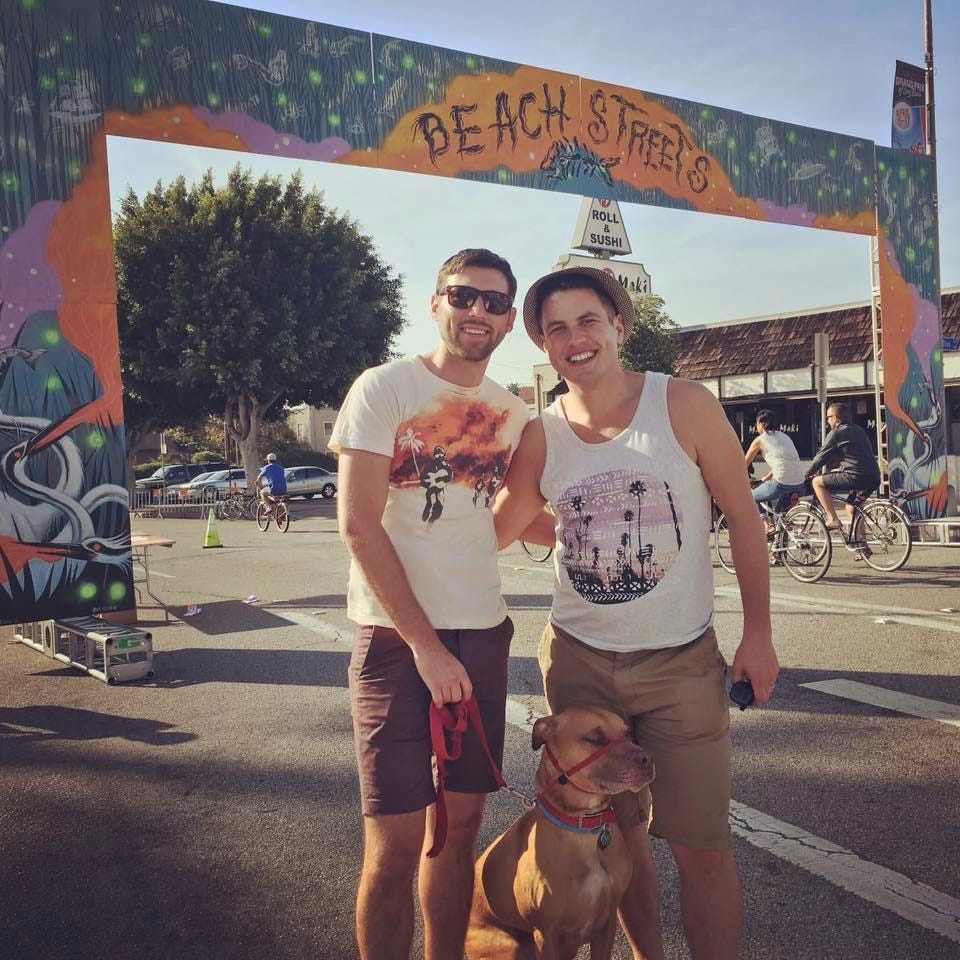
With our dog Cooper after our move to Long Beach, CA in 2015.
Patterns
“The only people who understand a marriage are the two people in it.”
― Hillary Rodham Clinton
For well over a decade, Nate and I had a deep, abiding love and an almost instinctual connection. Still, there were patterns I struggled to understand.
First: in an argument, Nate sometimes ghosted. He’d leave — the house, the car (even at a red light), a public place — and be gone for ten minutes, an hour, longer. Space can be healthy; silence without communication, at least for me as the product of divorced parents, felt like a slow-burn panic. Eventually we learned, in therapy, to set boundaries: if either of us needed an hour away, we’d say where we were going and when we’d be back.
Second: Nate often struggled to share feelings until they erupted. I’d ask and push — the anxious part of me always trying to understand — and when he did open up, it could be messy, but we always seemed to find our way back.
And there was another pattern that revealed itself over the years: when overwhelmed or cornered, Nate could be impulsive, even vindictive — threatening divorce in heated moments, then backtracking with apologies. It scared me how fast his kind, loving personality could switch, as if a different person had stepped into the room–only to vanish again.
For fifteen years, I assumed these behaviors were simply Nate’s ways of processing, as I had mine. I would soon learn later that something deeper — and darker — was happening.
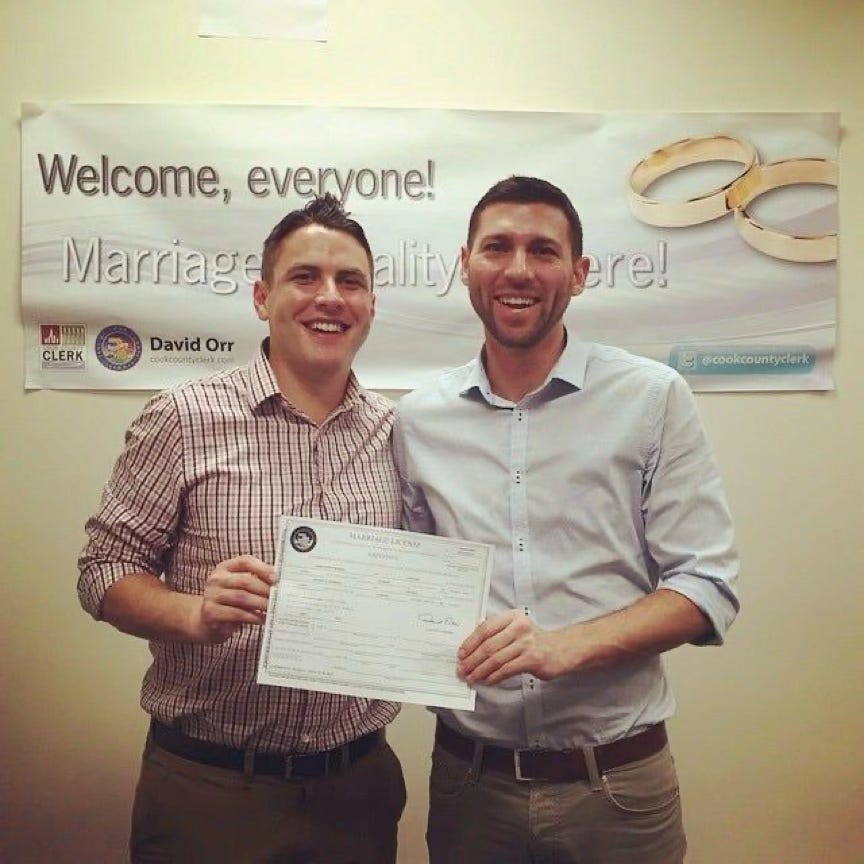
Getting our marriage certificate in Chicago, Illinois, shortly being our wedding in July 2015. After the U.S. Supreme Court legalized same-sex marriage in the Summer of 2015, holding this certificate felt like a monumental achievement — not only for us personally, but for generations of same-sex couples who could only dream of such a moment.
Roots of a Fracture
I have to allude to the roots, because they matter — and as Nate’s partner and husband for nearly two decades, I was aware of them, though not of their true impact until it was far too late.
We both knew that our upbringings were very different. I was the child of two Jewish, liberal parents, raised between New York City and central New Jersey. Nate grew up in rural central Michigan, the son of parents who had been together for decades and the grandson of a couple who had been together even longer. His childhood, as he described it, was full of horses, barn cats, and open fields. Mine had skyscrapers, subway rides, and Chinese food on Friday nights. The contrasts were stark, but as the saying goes, opposites attract.
The deeper, more consequential differences came later. My mother consistently gave my brother and me permission to love whoever we wanted to love — of any gender — as long as we were happy. Nate’s adolescence was far more punishing.
In his late teens, while trying to come to terms with his sexuality in an environment that was anything but welcoming, Nate developed feelings for a male exchange student while under immense pressure to keep dating his evangelical Christian girlfriend. Around that same time, he experienced profound abuse from a man he once considered a mentor. At his mother’s urging, he was also sent to several sessions of conversion therapy.
Years later, a high school friend of Nate’s — who attended our wedding — told me quietly that Nate had “disappeared” in college, not long after the abuse, and that when he returned, he wasn’t the same. His friends and family were so worried they feared he might not come back at all. Nate himself eventually admitted to me that around that time, he began living a “double life” — perhaps as a way to survive in environments where being fully himself was dangerous. It was then that he learned to hide the parts of himself that felt shameful and to present another version that felt more acceptable to the world.
I once believed that this early fragmentation — the splitting of who he was from who he thought he needed to be — was something Nate had already confronted and healed long before we met. I was wrong.
None of this history excuses what followed. But it does help explain how a loving, deeply sensitive man learned to survive by dividing himself in two.
And while it devastated me to witness, there was nothing I could do to heal the wounds that had been festering for years inside the man I loved so deeply.
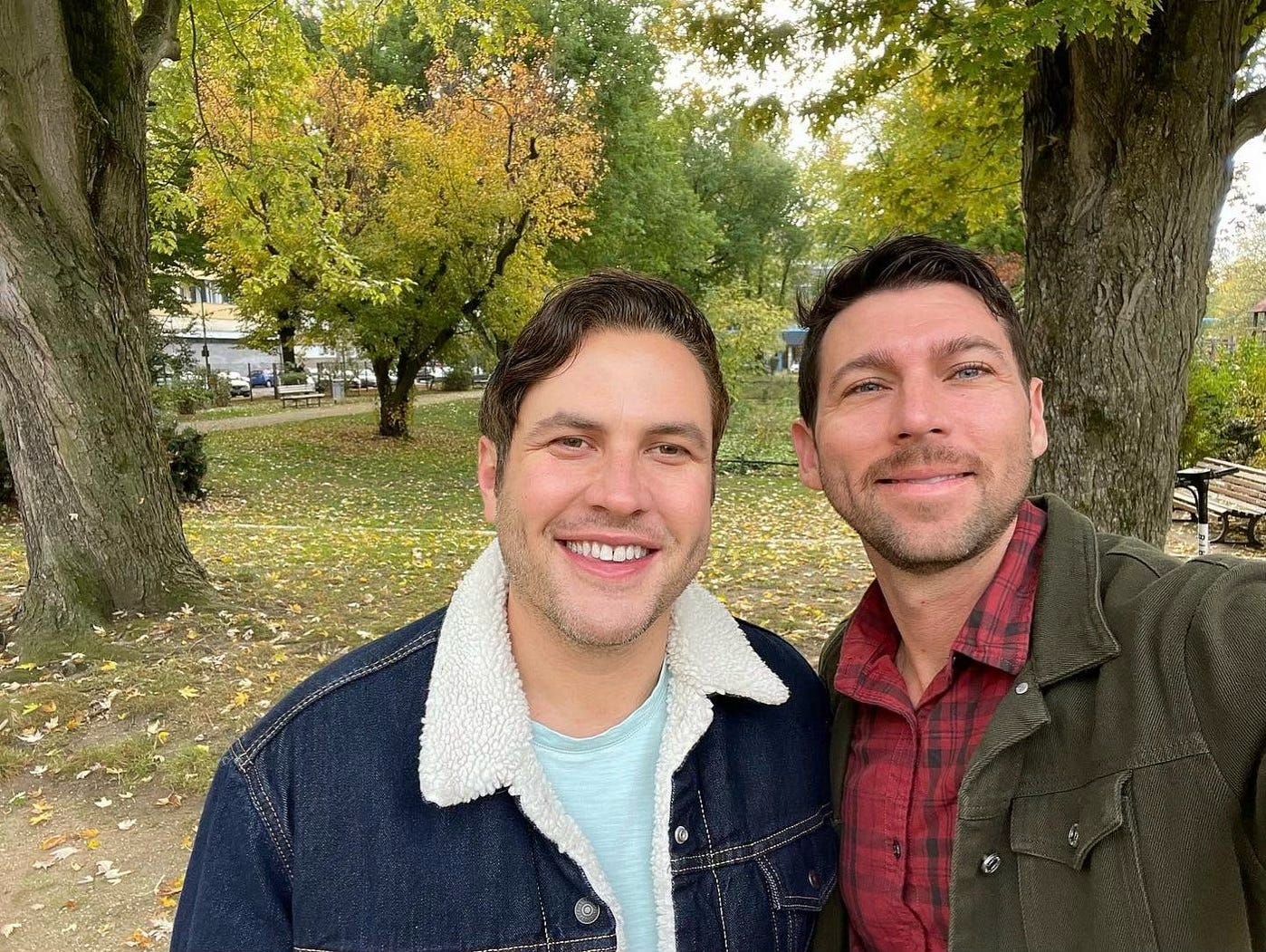
With Nate in Berlin, Germany, in October 2022. We loved to explore together, and Berlin was quite a fun city to experience.
The Summer of 2022 and the First Hairline Cracks
During our relationship, we had entered couples therapy only a few times — first in 2014 in Chicago, after our arguments had worsened around the boundaries (or lack thereof) of our still-young relationship. Later, while we lived in Long Beach, CA, we began couples therapy in February 2022 to reduce volatility and find healthier conflict-resolution. For a while, it seemed to work; we’d hold hands after each session, get our usual vegan takeout, and watch the latest episode of our favorite TV show.
Then in July 2022, I noticed changes I couldn’t place. Nate, I learned, had secretly co-signed an apartment lease for a coworker who he had also been sexually — and romantically — involved with over the years. Financial decisions were things we discussed together. I was horrified, for multiple reasons: feelings of betrayal, being deceived on our finances, and the fears that Nate could lose his job. I had made my own mistakes with our finances over the years, for sure, but this felt quite different. After a heated argument in which Nate called 911 on me (a pattern he would continue years later), Nate apologized, removed himself from the lease, and said that he would stop talking to the coworker. We tried to move on, but my trust in him was already fraying.
Soon after, I learned that Nate had paid a personal trainer he found on Instagram for five sessions — something he hid from me. I would have been jealous — the guy was attractive — but this level of secrecy felt new, and even disturbing. Trust began to erode even further, including when I saw text messages (and photos) on his phone that were sent to men I didn’t know.
Nearly a year later, in May 2023, I returned from overseas work travel to find more dishonesty — minor details about a carefully pre-planned, platonic hangout with Brian Hertz, who had been our close friend and former boyfriend. When I confronted Nate, he became unexpectedly emotional and said he had a “need to please people” and difficulty controlling whether he was honest or not.
The admission frightened me — particularly because the details he omitted about spending time with a then-close friend of ours weren’t particularly meaningful. We’d both been imperfect with honesty over the years, but this felt far more profound — as if Nate himself sensed something shifting inside him. We agreed he’d see a therapist and we’d address it in couples therapy.
Neither of that really mattered, as perhaps it was far too late.
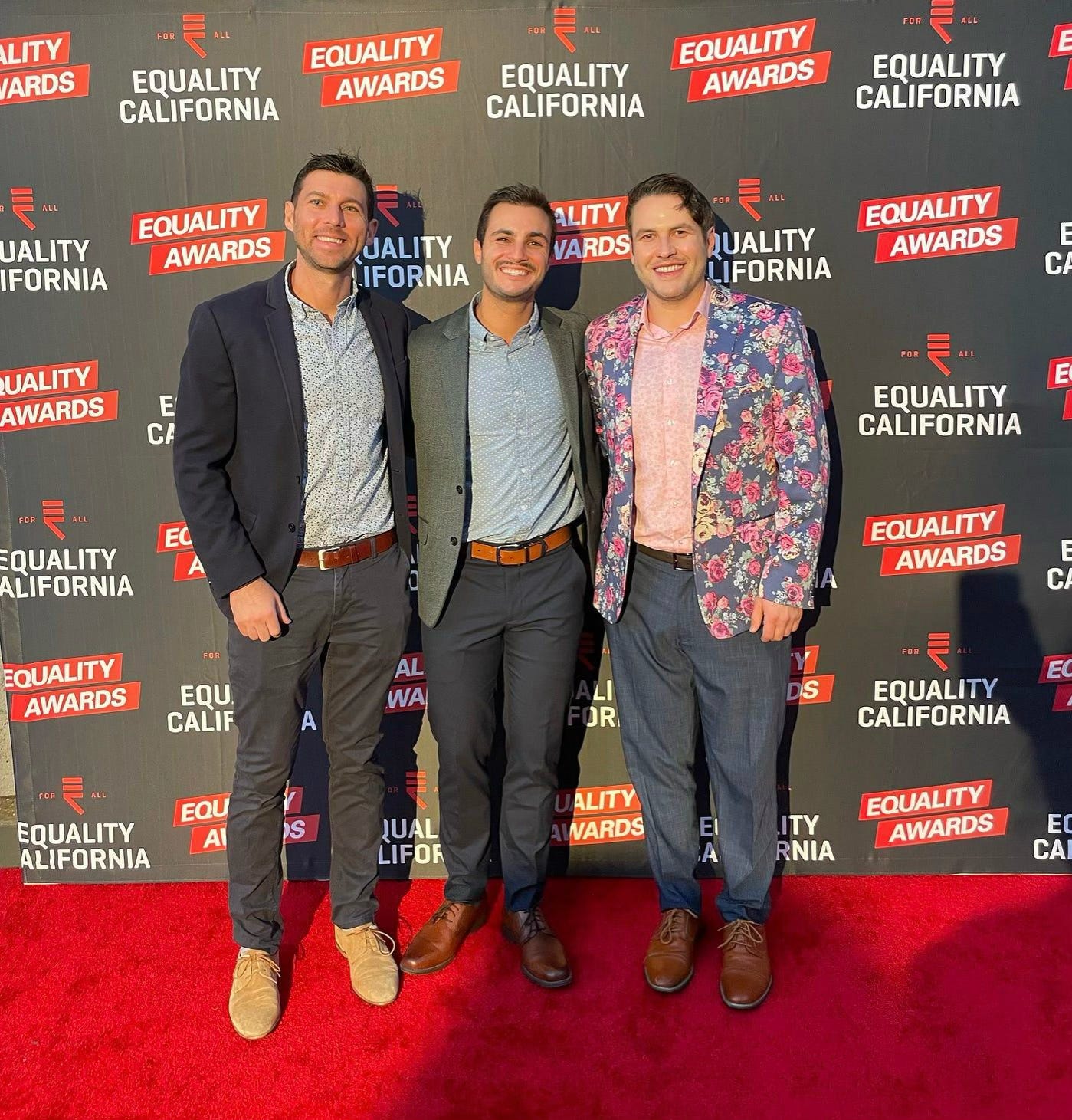
With Nate and Brian Hertz in Los Angeles, CA, in October 2022
Meeting Brian
By November 2021, Nate and I had been together for twelve years and lived in the LA area for six. We met Brian Hertz at a Jewish queer event. Younger by nearly a decade, he felt attractive to me at the time, Jewish, gay, charismatic, funny, warm, and kind. That night, a group of us ended up at a friend-of-a-friend’s place, playing “Never Have I Ever” and “Truth or Dare.” It was the beginning of many experiences — and a two-year relationship between Nate and me and Brian.
We began seeing Brian occasionally, then more often. After years of being monogamous, “monogamish,” and everything between, Nate and I talked at length. We both found him attractive and felt a deeper connection. We had never added anyone to our relationship. Brian was different.
In early 2022, we traveled with Brian and friends, cooked, laughed, went to parties. He became a confidant — someone I loved and trusted, someone who brought new levels of levity and joy into our lives. By late spring, before an event, we all agreed to call Brian our “boyfriend.” New terrain that, for me, felt exciting at times but also uncharted and unknown. Worth exploring, we thought, even though I (and our couples therapists) had both fears and concerns, particularly given the ways in which trust between Nate and me had frayed over the years.
Brian invited us to Shabbat dinners at his childhood home. His family was warm and funny. For me, it was a homecoming of sorts: I’m Jewish but wasn’t raised with many traditions except for celebrating Hanukkah every year as a kid, and so pausing for Shabbat felt calming and meaningful. We attended several dinners; we met his siblings and extended family. To my knowledge, he told his parents we were “friends,” disclosing more to siblings. Either way, he was more than a friend to us.
Trips escalated as our relationship deepened, even as several friends warned me about including another person in my relationship with Nate. Snowboarding with friends in early 2022, camping on Catalina Island, Chicago for Market Days, Puerto Vallarta with friends the next year, hikes with the dogs, beach days, vegan restaurants, video games, cooking. Brian even read a book called Three Dads and a Baby within weeks after meeting us, which at the time felt quite premature to both Nate and I. Brian stayed over many times in our home, watched our dogs when we traveled, met my mom and our close friends, and widened our circle in a city where friendship can be hard.
To proceed in the relationship with Brian, I needed trust, respect, honesty, transparency, vulnerability, empathy — and clear boundaries that protected our marriage. We laid them out in therapy: (1) communicate with Brian via shared text chains; (2) talk on the phone together; if separately, do so equitably with full transparency and frequent check-ins; (3) no in-person time alone without prior approval from both of us. After an early stumble (before boundaries existed), we all agreed there would be no separate sexual contact with Brian.
Boundaries can chafe, but they are guardrails. We all agreed — explicitly and repeatedly, including in therapy together — and, for a while, the structure worked.
Until the ground shifted in early 2023. I was increasingly anxious about Brian and wanted to refocus on my marriage with Nate. We joined an LGBTQ+ kickball league; by random assignment, Nate and Brian were placed on one team and I on another — a coincidental pairing that would be oddly prophetic of what was to come. Tensions grew.
Soon after, the romantic relationship ended. Brian told us he wanted “out” and to date other people. He reiterated — again — that he would “never hurt” either Nate or me, would never have a separate relationship with either of us, and would never harm our marriage or come between us. I once joked with Brian that he could end up dating Nate. He said, emphatically, that such a thing “would never happen.”
I believed him.
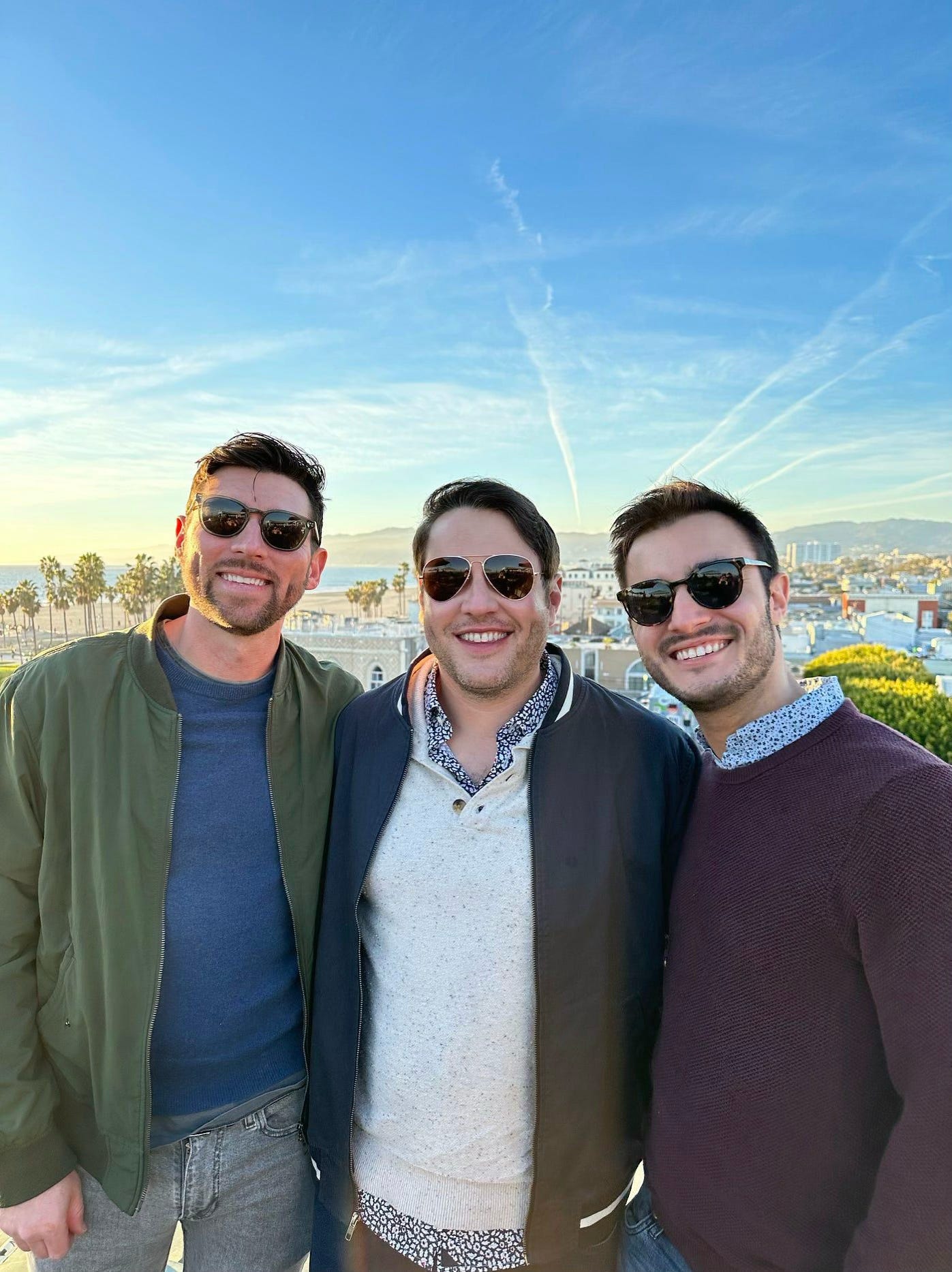
With Nate and Brian Hertz at my birthday party in Los Angeles, CA, in February 2023. By the end of that year, the betrayals would begin.
The Unraveling
The fall of 2023 was a blur of disappearances, reversals, and confusion as Oliver’s cancer worsened — after months of Nate saying he felt like we were on “different wavelengths” and repeatedly asking in therapy for an open relationship (again). I eventually said I’d be open to some form of ethical non-monogamy — if it truly felt ethical, if it was mutual, if it didn’t feel like abandonment. But the truth was simpler: I just wanted my husband back. Yet the harder I tried to reach him, the farther he drifted.
The man I loved no longer looked like the man I’d married. His eyes were still the same soft blue, but the light behind them had dimmed — replaced by a haunted vigilance, as if he were being chased by ghosts only he could see.
In September — just weeks after a serene trip with my mom to California’s wine country for her eighty-first birthday — Nate told me in our home that he felt “numb, trapped, overwhelmed, and scared.” I didn’t know what to say; in fifteen years together, I had never heard him use those words. I urged him to get professional help, though I didn’t yet understand why he felt scared. I later learned that such language is common among survivors of deep trauma — but at the time, I couldn’t have known.
Around then, as Oliver’s health declined, longtime friends started reaching out. Their messages were all the same: What’s happening to Nate? They said he’d stopped replying, gone quiet, detached. In group texts once full of jokes from both of us, his name no longer appeared.
In late September, I left on an early-morning work trip to Lake Tahoe. The day before, I’d told Nate and Brian that I was okay if they got coffee while I was gone. We all still considered Brian a friend, even though the romantic part of that triangle had ended nearly six months earlier. Still, I felt uneasy. My trust in Nate was already fragile. But I wanted to show faith in him, so I agreed.
After landing in Reno, I rented a car and began driving toward the mountains. I’d been struggling with chronic migraine with persistent aura, and as I ascended into the thinner air, the shimmering in my vision intensified. The high altitude pressed in; cars sped by on narrow roads. Claustrophobia turned to panic. My body went into fight-or-flight. I pulled onto the shoulder, shaking, gasping for air.
And then I called the only person I’d ever call in a moment like that: Nate.
It was just after 9 a.m. He answered. I told him I was panicking on the side of a mountain highway, that I didn’t know what to do. It reminded me of a time years earlier when I’d had a panic attack after taking a cannabis edible — except this felt far worse. I told him I was terrified.
Instead of comforting me, Nate said he had to get back to work. That he had a meeting starting soon. That I should call my mom.
I begged him not to hang up. I was scared and alone.
He hung up anyway.
My mom didn’t answer either, so I called 911. Paramedics came and helped me calm down, guiding me over a bridge between the mountains. I eventually pulled over again, ordered an Uber, and made it to my work meeting.
Later, while standing at the edge of Lake Tahoe, I called Nate again. He apologized — weakly. I asked him not to meet Brian that day, because I was shaken. But he did anyway.
That was the first time I truly felt the coldness forming inside my husband. The self-centered insistence on doing whatever he wanted, no matter the cost. I’d seen flashes of it that summer — like the night he bailed on a friend’s birthday party, stormed out, and said he might hook up with someone “just because he could.” He didn’t that night, but the threat lingered like smoke.
By October, something inside Nate had cracked.
Early that month, he told me for the first time that he wanted to separate — and, somehow, Brian was involved in the middle of it.
On another work trip, Nate was supposed to meet me in New York City so we could see my stepmom and a few old friends. He threatened not to come but showed up at the last minute. We walked through Central Park for almost an hour, retracing the same paths we used to run with Cooper when we lived on the Upper East Side.
For a while, it felt peaceful — like maybe we could find our way back. But then, out of nowhere, Nate said again that he wanted to separate.
I didn’t understand what he was running from. I knew he wanted an open relationship, but I no longer trusted him enough to try. I walked down Manhattan’s long avenues, crying, and called my mom. She gently suggested divorce, given Nate’s erratic behavior, but I wasn’t ready. I texted Nate’s parents, worried about his instability. They never called or offered to help.
We flew home together in silence. In my text to Nate’s parents in New York City, I had told them that Nate wanted to be in relationships with other people — which was true — and that I couldn’t be with him if that was the case. I even suggested that we might have to live apart if the cycle continued.
A few weeks later, on a quiet Sunday in October, we went for a walk through Culver City. We weren’t yelling, but the air between us was tense. He had been vanishing for days at a time without explanation, leaving me to care for Oliver and Dolly alone.
“I can’t be with you anymore you, Jared,” he said.
“That doesn’t work for me,” I replied. “You can’t just abandon us again.”
He said he wanted to call his parents. I told him he could call them right there, as we walked outside in Culver City. He refused.
We kept walking in circles until, suddenly — without a word — he bolted. Full sprint down the street. I froze. A small, bitter laugh caught in my throat.
What was my husband doing? Where was he going?
That day, we were supposed to drive to see my mom, as we often did on Sundays. Instead, Nate vanished — ghosting me, the dogs, and her all at once. Hours passed. I finally drove to my mom’s house alone, trying to make sense of what had just happened. I called Nate’s brother; he didn’t know where Nate was either.
When I got home later, the house was still. Dolly greeted me at the door, tail wagging nervously. Oliver, weak with cancer, lay on the bed, barely moving.
Nate was gone.
I checked our Ring camera and froze. Police officers stood at our door, pounding and shouting my name — voices sharp and urgent. I later learned that Nate had called them, saying he thought I was suicidal.
I wasn’t. But I had told him I was struggling, that I didn’t know if I could survive him leaving again — and that was true. Seeing that footage, hearing my name screamed into the night by strangers with guns, not knowing they were coming — it was chilling. Like stepping into someone else’s delusion.
Hours later, after unanswered texts and calls and Nate refusing to tell me where he was, I found him. He was at a hotel near the airport.
Nate cracked the door open when I arrived, the chain still latched. He looked terrified — a ghost of himself, eyes wide, body trembling. He was on the phone with his brother. I urged him to come down to the lobby to talk. His suitcases were packed, though I doubt he knew where he was going.
In the lobby, his face was drawn and pale. I was shaking, in full trauma response — panicked, overwhelmed, disoriented. We talked for a while before he agreed to let me upstairs. There, he broke down completely — crying like a child. I held him, told him he wasn’t alone, that we’d get help together.
That night, he came home. But something essential had already shifted.
In that hotel room, I realized I wasn’t just talking to my husband anymore — I was talking to his fear, to the parts of him that unhealed trauma had splintered. And though I didn’t fully understand it yet, I knew something was unraveling that love alone could no longer hold together.
The pattern continued. November bled into December. Nate disappeared again — Airbnbs, cryptic texts, lies. He threatened to hook up with other people, went silent for days, then reappeared as if nothing had happened.
In late November, during a brief visit to our home to walk Dolly (at my urging) while he was staying at an Airbnb, Nate said that he was going to dinner with Brian and “friends” — without me. It was a clear violation of the boundaries we had set. I told Nate so. In front of our home in LA, I even called Brian, with Nate standing right next to me and our car, begging them both not to go. Neither cared. Brian suddenly yelled at me over the phone and hung up. Nate drove away in our car to meet him. I stood in front of our house, helpless.
By this point, I had already changed the locks on our house, not knowing what was happening to the man I thought that I had known so intimately well for 15 years. Even though Nate was already staying at yet another Airbnb, I eventually gave Nate a key to come home — as he slowly seemed return to a version of the man I had known for so many years. Sadly, though, his transformation was nearly complete.
A few weeks later, Brian texted and left a voice memo.
“I want to apologize for yelling at you the last two times we’ve spoken,” he wrote. “You don’t deserve to be treated this way… I know this has got to be the worst you’ve felt in your life — I don’t want to be making things worse, and I know I have been. I’m really sorry.”
I responded that I’d be willing to talk if he could commit to no more outbursts. He agreed — or so I thought.
The next day, he sent a voice memo:
“Hi Jared, I’ve been thinking about it a lot and talking to my therapist, and I’ve decided I’m too wrapped up in this dynamic. It’s not good for me, or either of you. So I’m pulling out completely. I won’t talk to you or Nate for at least a month. I hope you’re okay and have a wonderful December.”
I didn’t respond. I was relieved. I believed him.
I was wrong.
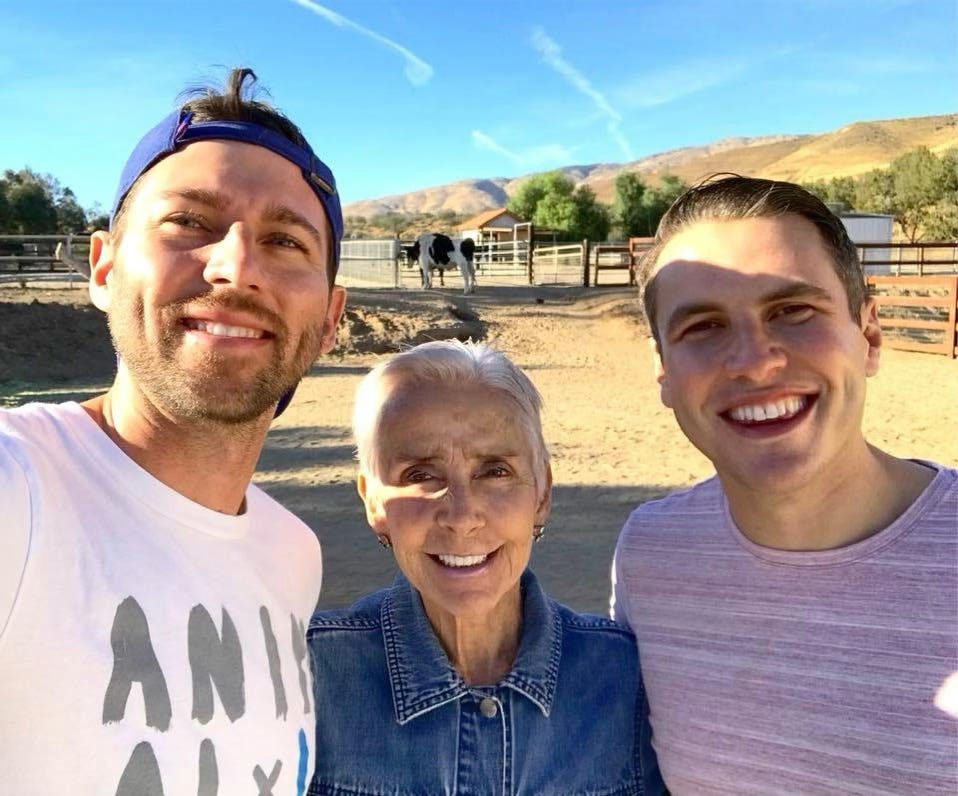
With Nate and my mom, Jan, at a farmed animal sanctuary in Southern California, circa 2019. My mom and I went vegan in my early teens, and Nate followed suit shortly after we met in November 2008. Our love for animals — and rescuing them — was a shared bond throughout our many years together.
A Friday in December
“Betrayal is the only truth that sticks.”
— Arthur Miller
Friday, December 22, 2023 began like a somewhat normal day. After months of Nate booking Airbnbs without notice — saying he wanted to separate, then coming home again, then vanishing for days or weeks again, then saying he wanted to hook up with other people, then not — I felt a bit of peace at home with Nate.
He had been home for several weeks by this point, and we had just gone for a hike together with Dolly a few days prior, and saw a new movie, Maestro with Bradley Cooper, and a new TV show, Fellow Travelers (about a gay couple that reconnects after many years apart) in recent days. In fact, the night prior, we cuddled on the couch as usual while we watched the final episode of Fellow Travelers and ate vegan takeout. We cried as the credits rolled, after watching a heartfelt story about the highs and lows of queer love felt over many decades despite tragedy and trauma. I didn’t realize it at the time, but that evening would be oddly prophetic of what was to come.
The following morning was a sunny, warm day in LA. I tried on some new clothes while we both worked from home; Nate said he liked them. We talked about plans for the weekend and New Year’s, which was upcoming, and Nate asked me if I had a session with my personal trainer that day at the gym — just a short scooter ride from home. I said I did, for an hour as usual, at 1 p.m. We had both been under the weather that week, and Nate said he would work from home. I said goodbye to him and Dolly as I rushed out the door to the gym. When I left, Nate was at home working.
After I finished my session, I realized that my scooter had stopped functioning. So I decided to walk home and call a longtime friend from college, who Nate had also known for many years. As we caught up, my friend asked how Nate and I were doing. I said that Nate still seemed quite withdrawn, depressed, erratic, and at times, unusually moody. My friend asked if I had considered a divorce; I said I had at times, but that I loved Nate immensely and he seemed to be doing a bit better than before. Ultimately, I still had hope that things would improve. Earlier that day, in fact, our couples therapist suggested some in-person therapists who could help us — and we had been through many tough times before.
I finished the call with my friend and entered our home through our garage, as usual. Dolly was waiting by the back door near our yard, wagging her tail, as she normally would — except the house was eerily quiet. I didn’t at first notice that our shared property — and one of our cars — was gone, in part because I assumed Nate had gone on an errand or to work out. Instead, a few minutes later, I received a casual text message from Nate: “Call me when you get back from the gym.” When I called, thinking that he had something mundane to share or was going to ask about dinner plans, Nate said, flatly: “I filed for divorce.” He had packed suitcases, taken our car and whatever items he could grab in a hurry (including our beach umbrella and a few vinyl records), turned off our Ring camera to conceal his actions — and vanished.
After our call, I noticed that Nate had locked me out of one of our bank accounts, so I called him back and asked him to give me the new login. He answered when I called, and in the background I could hear some commotion.
“What are you doing?” I asked.
“Moving some stuff.”
“Where?” I said.
“I can’t tell you,” Nate replied. “Somewhere in Southern California.”
It was extremely odd. I asked if Nate would meet me, and said — as calmly as I could — that I was sad to hear about his decision, and wished that we could have discussed this a few days prior when we were both at home. I then asked Nate if we could meet to talk. After a bit more discussion, Nate agreed to meet at 5:30 p.m. later that night at a coffee shop near our home.
My mind was spinning. I called my mom, and she was flabbergasted: “Oh my,” she said, after hearing the news (Nate had just seen my mom a week or so earlier, as we helped her with things around her apartment). I was speechless.
I walked Dolly and fed her, and called our couple’s therapist, who was also shocked. “I didn’t realize that Nate would decompensate so quickly,” he said to me, as I sat alone in our garage. Our longtime friends were equally bewildered.
Just before 5:30 p.m., I walked to the coffee shop to meet Nate. After I arrived, waiting in the garage, Nate called and said he “can’t make it” because he was “45 minutes away and driving to San Diego.” He said he had been staying in Long Beach, but I didn’t believe him — and now he said that he was driving to San Diego. Understandably, I was quite angry and exhausted. I urged him to come back and to keep his commitment to meet. He refused and hung up on me, as he had quite a few times before when he wanted to retain control or vanish again.
I called several of our mutual friends, who invited me to come over for dinner — and urged me not to try to find Nate. I obliged. I went to their home, and with tears in my eyes, recounted what was happening. They were also shocked, as they had known Nate and I for years, and saw us together very recently. They offered their support. I went home.
The next day, I texted Nate and asked if he would meet for coffee at the same coffee shop as he had he night before. He said he would, and that he’d be there this time. I also asked Nate to forward me the divorce filing. He did — and indeed, it was real. Nate had gotten a lawyer through LegalShield, a discounted legal service that he could obtain through his employer. This was really happening.
When Nate arrived at the coffee shop, he looked like a ghost — tired, zoned out, barely eating. We walked, we tried to go to Urgent Care at my insistence (it was closed), he vomited in our bathroom at home, we walked Dolly, and walked around our neighborhood. At a coffee shop, we sat for a moment. Then, Nate told me that he “didn’t want to be with me anymore,” and said that he would “move to London, go to San Francisco, and drive to Michigan to see his family.” It was all deeply confusing and, honestly, made no sense — but this was just the beginning of an extended waking nightmare. I placed my hand on Nate’s arm and tried to soothe him — but he was cold, numb, non-responsive.
Nate said that our other car was at the dealership where we had bought it and was being repaired, but he didn’t want me to have it. I called the dealership in front of Nate — and they hadn’t seen our vehicle for years. Nate had lied, yet again, to my face.
As we walked and talked around Culver City near our home, Nate suddenly led me into a police station. Once we got inside, Nate told the officer at the window, “My husband won’t leave me alone.” I explained that I was worried about Nate’s mental health, and urged him to get help. A few minutes later, an officer spoke with us, offering divorced-straight-guy advice. If it hadn’t been so serious, it would have been funny. The officer told us to at least spend Christmas together, and we left.
Outside of the police station, I finally convinced Nate to let me drive him to Urgent Care — but he refused to let me come in with him. Before he got out of our car, Nate promised to text me later that night and tell me how it went.
I knew he was likely lying — and he was. He never called.
The day after, I became increasingly worried about Nate because I didn’t hear from him, and his behavior had become increasingly erratic and fragmented over many months. Now, he was gone again — after promising to check-in with me.
In those days after Nate’s latest disappearance — when he wasn’t responding and my fear had tipped into a constant fight-or-flight — I posted an Instagram story with a photo of the two of us. I wrote that I didn’t know where he was, that I was worried about his welfare, and asked him to contact me if he saw it. Friends reached out with concern and offers of help.
Then Brian called — despite his promise not to contact either of us.
I remember it viscerally. I was staying with a longtime friend (also a longtime friend of Nate’s) because I didn’t feel safe in the house where so much of the trauma had unfolded. Dolly was curled beside me on the couch. It was the week between Christmas and New Year’s, and Dolly and I had been there for several days.
At first, Brian sounded supportive. He said he’d seen my Instagram story and asked what was going on. Calmly, I told him: Nate had been home for several weeks; we’d hiked with Dolly, watched Maestro and the finale of Fellow Travelers, and even made tentative New Year’s plans. The Friday in late December when I went to the gym for an hour, he was gone. He’d promised to meet, then said he was driving to San Diego; said he’d meet the next day, then announced he was moving to London, going to San Francisco, and driving to Michigan. I told Brian I was very worried; Nate had promised to text after Urgent Care–but never did.
Then, suddenly, Brian flipped. His tone sharpened and he began to yell — the same behavior he’d sworn to stop. He said I could face “legal action” for posting my concern on Instagram — absurd, but threatening. He told me maybe I was the unwell one, not Nate. He berated me, blamed me, and then — without answering why he’d called after promising not to — said he was blocking my number and hung up. It was textbook manipulation: feigned concern, then sudden cruelty when reality didn’t fit his narrative.
Only then did it hit me: in a few weeks we were all supposed to go to Puerto Vallarta with mutual friends for Presidents’ Day weekend. I had booked my flight with Nate several months earlier; Nate and Brian were ticketed together, seated a few rows behind me. Nate and I had also booked an Airbnb together in Puerto Vallarta with several of our LA friends, including Brian.
But now, the idea of being anywhere near Brian felt impossible. I emailed them both: I was troubled by Brian’s call and his broken promise to stay out of it. In my email, I asked Brian to keep his commitment not to talk to either of us and to stay out of an increasingly painful and traumatic situation. And I said quite clearly that I wouldn’t be comfortable sharing the trip with him.
Instead of calling to tell me where he was — or asking how I was, or Dolly was doing, who he had abandoned yet again — Nate replied to both of us that he had canceled the entire Puerto Vallarta booking. He’d made the reservation through Airbnb on a joint credit card, so I couldn’t access it. Soon after, I learned Brian had re-booked the exact same place for the same dates with the same group of friends — minus me. It was vindictive, petty, and cruel. Two of my closest friends in that group were equally unsettled by Brian’s behavior and invited me to stay with them instead, saying that they wouldn’t stay with Brian. I appreciated the offer and said I might still go.
As February approached, I was working with an interventionist to try to help Nate — this was only weeks after he had ghosted me on my birthday yet again, after promising to be there with me. At the last minute, after consulting with my therapist and wanting some time away from the chaos and trauma in LA, I decided to make the trip to Mexico and stay there alone. On the plane, Brian walked past, pretending not to see me, looking out of sorts. Nate didn’t go; Brian brought someone else. I stayed in my own place, but I could barely focus or relax — still in panic, still scanning, still discovering new credit card charges on joint accounts that confirmed Nate was lying and vanishing again.
After about two days, I flew back to LA alone.
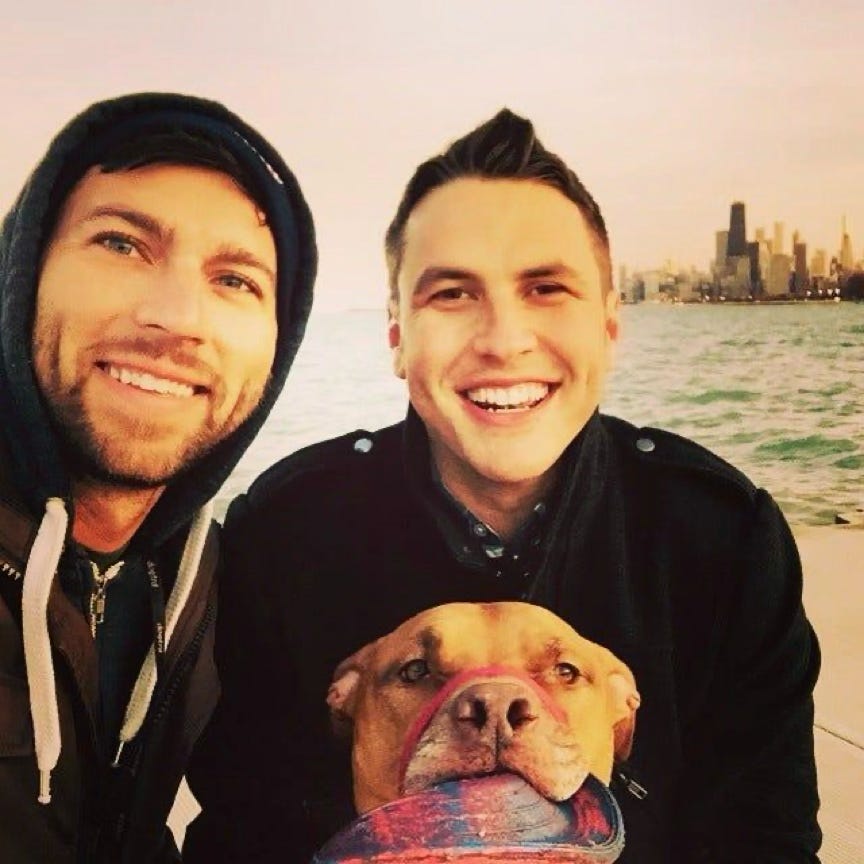
With our rescued dog Cooper (and his favorite Chewber) on a very cold day in Chicago, IL, circa 2014.
The Spiral
The weeks that followed after Nate secretly filed for divorce in late December 2023 were terrifying — and the lies by Nate increased and became often bizarre, including:
When he told me that he was at a yoga class in Orange County taught by a coworker (I confirmed with that coworker that she had stopped teaching yoga a month earlier);
When he told our landlord that he couldn’t meet with him because he was flying to Michigan that day (he wasn’t);
When he told me that he was at a coffee shop and would meet with me but wasn’t there when I arrived a few minutes later;
When he said he was staying at a particular Airbnb but wasn’t there either;
When he told police officers that he wouldn’t take any additional property from our home, but then did anyway;
When he said he was staying in Long Beach–-but was actually in West Hollywood.
And on and on. Often, it felt like the lies came more often than the truths, and reality itself became something harder and harder to grasp.
In a futile effort to figure out what was happening, I called numerous crisis teams, mental health programs, psychiatrists and therapists. I kept getting the same questions from the experts I spoke with: was Nate using drugs? Was he abusing substances? Did he have any mental illness in his family? Has he been diagnosed with any mental health issues before? What were his symptoms?
I knew the answers to some of these questions–-but not all. Terms like “psychosis” and “decompensation” were said to me to describe Nate’s behavior and actions several times, as well as “addiction” and “substance abuse”; later, “complex trauma disorder” and “hypomania” were used to describe him by a psychiatrist who evaluated him in early January 2024. A personality disorder was even suggested; several clinicians told me that Nate could be abusing substances of some kind, but we couldn’t prove that without a drug test. And, at the time, Nate repeatedly denied that he was taking any substances–except that he had taken edibles recently, and was prescribed various psychiatric medications. Nate eventually agreed to take a drug test, but he never did. Whatever was happening, I was relentlessly trying to get to the bottom of it — because being alone and doing nothing felt like an impossible option.
In late spring 2024 — at the height of Brian’s ongoing betrayal and the cycle of harm he was helping perpetuate — a friend sent me an Instagram story of Brian promoting a panel he was moderating on “fostering respect and inclusion for LGBTQ+ Jews in America.” There he was, working for a Jewish advocacy nonprofit, while simultaneously and knowingly harming a gay Jewish man: me. I used to write films for fun, but even I couldn’t script irony this dark if I tried. I briefly considered attending the event to ask about the hypocrisy publicly — but ultimately chose to focus on my own healing instead.
Sometimes Nate cooperated with my efforts, often he didn’t. When I could finally reach him, he said that he was “safe” and “fine.” The problem, he explained, was me. He’d say that he simply didn’t want to be with me anymore — before doing more reversals and changing his mind again and again.
Indeed, Nate repeatedly promised to enter a treatment program — but ultimately never did. One night near LAX in early January, after I had located Nate at a hotel with LA County clinicians present, Nate and I made an agreement in writing: he would withdraw the secret divorce filing; I would withdraw a pending restraining-order filed by my attorney at the time; we would resume therapy and seek care. He agreed to medication management and therapy. I exhaled slightly. He agreed to go with me to the ER that night to get checked out, before telling an ER nurse that he was “scared” of me and vanishing yet again, while I arrived back at the ER after midnight with food for us to share together. Nate called me from his hotel that night, and we spent time together there and agreed to meet the following morning.
Weeks later, I discovered that Nate had secretly taken a snowboarding trip to Mammoth with Brian in our car, crashed it (after lying about how the accident happened), and admitted in couples therapy in January 2024 that they’d had sexual encounters on that trip and afterward.
Those confessions shattered something fundamental in me. I felt like I couldn’t breathe. But I also refused to let my marriage — and this man I loved — unravel like this.
That stubborn persistence, as it turned out, would go on to cause me even greater suffering for years to come — and also teach me profound lessons about life, loss, and love.
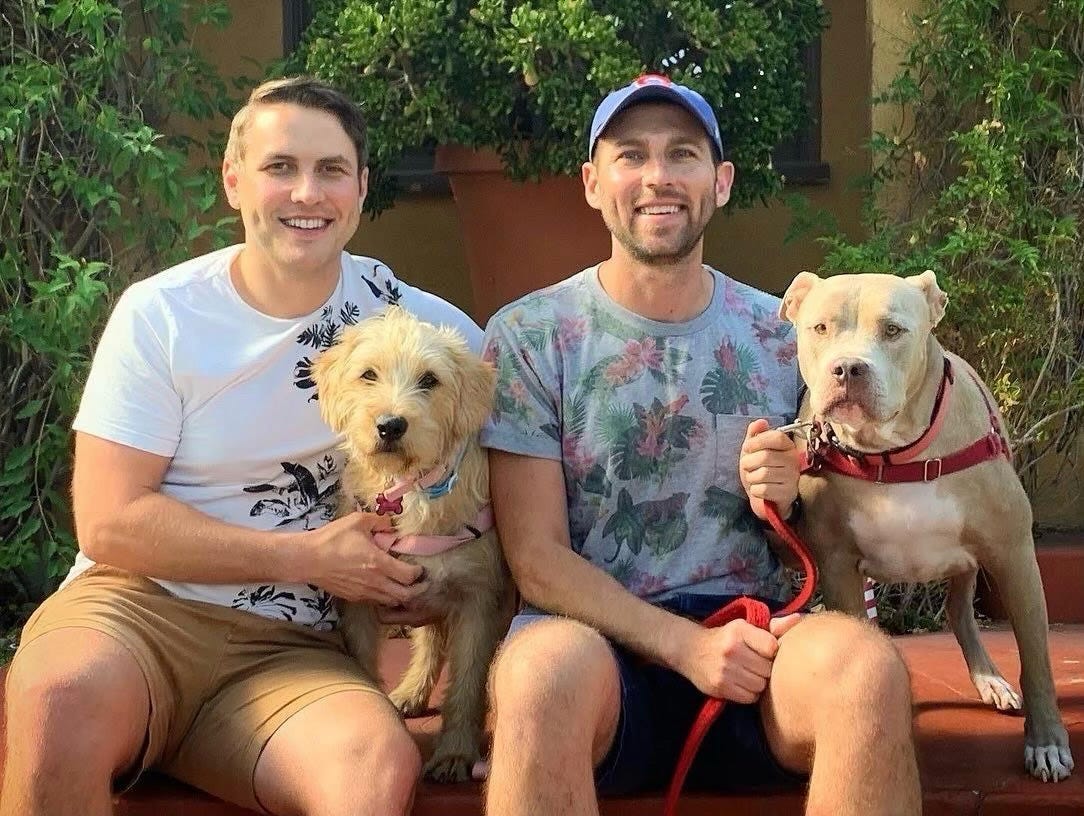
With Oliver and Dolly in front of our home in Long Beach, CA, circa 2020. We loved our home there, and our times walking Oliver and Dolly in the neighborhood are memories that I’ll always cherish. We both cried on these very steps on the day that we moved out. For a long time, being with Nate truly felt home — and I truly never thought that we would be apart.
Losing Oliver
Several months earlier, as all of this chaos began to unfold in late 2023, our beloved pit bull Oliver was dying. Despite radiation, antibiotics, scans — everything — his nasal cancer advanced. On a late-October night, after a violent seizure, we agreed to let him go — after Nate agreed that he wouldn’t separate from me again. We sat on the floor of the vet’s office, with Dolly by our side, told Oliver we loved him, and watched him slip away. A few days later, after days of crying together, Nate began separating from me again as he prepared to go to Europe for a work trip. The losses piled up.
On October 30th, 2023, Nate posted on Instagram to remember Oliver: “trying to balance gratitude with grief right now.” As I write this two years later, it is still essentially the last thing he posted. I often think of that as the day Oliver died and the day a part of Nate did, too.
He wrote beautifully about Oliver’s loss — and what it feels like to lose someone we love so deeply. I now feel the same way about Nate.
“Last night we said goodbye to our best friend Oliver. I am heartbroken but I will cherish all of the fun, silly times we had with this beautiful creature. He loved every human unconditionally, especially if they had food (hence his beloved nickname ‘pig’).
It can be so tough to say goodbye to our loved ones. Sometimes it feels like we are all just ships passing in the celestial night, yearning for some connection in an otherwise cold and dark universe.
1 am grateful that I got to spend a few cherished moments with this gentle, loving soul before he continued on to his next spiritual destination.
I will never forget you Oliver.”
And I will never forget the man I married — and the man I knew Nate to once be.
The Weight
by Jared Milrad
The weight
of holding
the dreams
of us,
of you —
as you were —
has, alas, become
too heavy
to hold
alone.
And so
I let go.
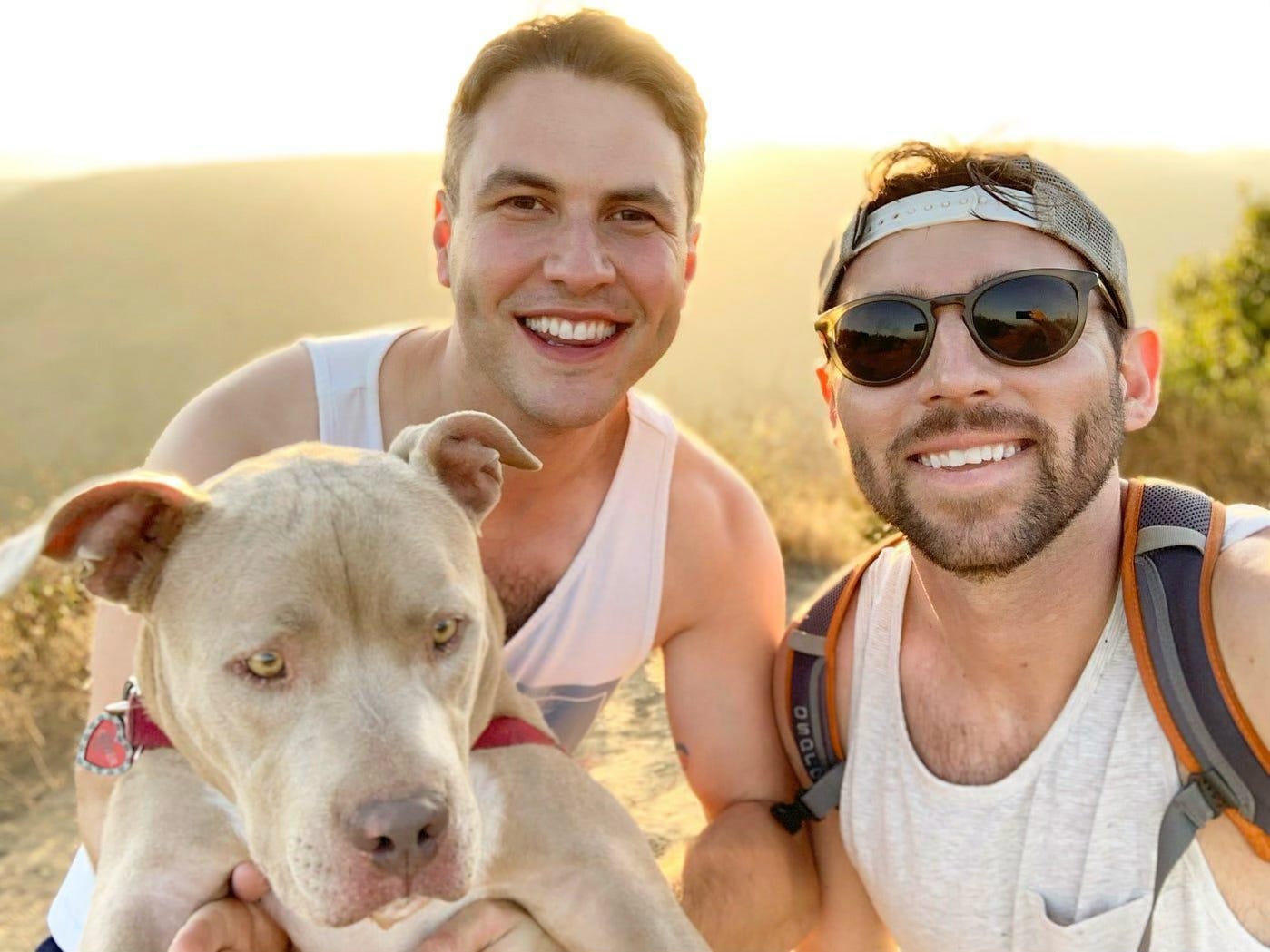
With Oliver “on Top of the World” — one of our favorite hikes in Laguna Beach, CA, in July 2019. Though he tired himself out eventually, Oliver enjoyed a long hike — particularly when there were good smells, critters to chase, and treats involved. I remember this sunset instinctually. Being with Nate and our dogs always felt like home.
Aftershocks
By early 2024, I was calling the National Suicide Crisis Lifeline multiple times a week just to keep breathing. I worked with trauma-informed therapists and a somatic/DBT clinician who eventually diagnosed me with PTSD. I contacted Brian and Nate several times by text and email, telling them that their interactions were causing me profound trauma and pain. They didn’t respond. When I drove by Nate’s apartment in LA, Brian’s car was often there–and even seeing a similar vehicle in LA became deeply unsettling to me.
Despite my pleas, Nate and Brian traveled — to Mammoth, Palm Springs, Joshua Tree, Portland, Alaska, Chicago — and planned others. It was like they were mocking me and taunting me to prove that they could do whatever they wanted. I begged them to stop. They didn’t.
On Nate’s birthday in March, we met for lunch. I brought poster boards and wrote memories to remind Nate how much I loved him. And yet the following morning, I learned — through a Google Calendar that Nate was accidentally still sharing with me — that Nate had planned a secret birthday party with Brian and other “friends,” saying with excitement that he was looking forward to smoking weed and celebrating his 39th birthday. The dissonance felt extremely cruel; but it, sadly, nothing new.
By summer, legal skirmishes over cars and spousal support occupied our time; a judge ordered payments by Nate to me for legal fees and more. Nate cried in our yard the day he collected one of the cars, saying that he felt “sad” for seeing Dolly and everything he had left behind, including all of our memories and remnants of our lives together. Then, Nate said he was planning to drive to Michigan with his parents and move to D.C. — a place I’d never thought he’d live, especially without me.
It was, in a word, a whirlwind of chaotic reversals and extreme trauma that I felt unable to escape.
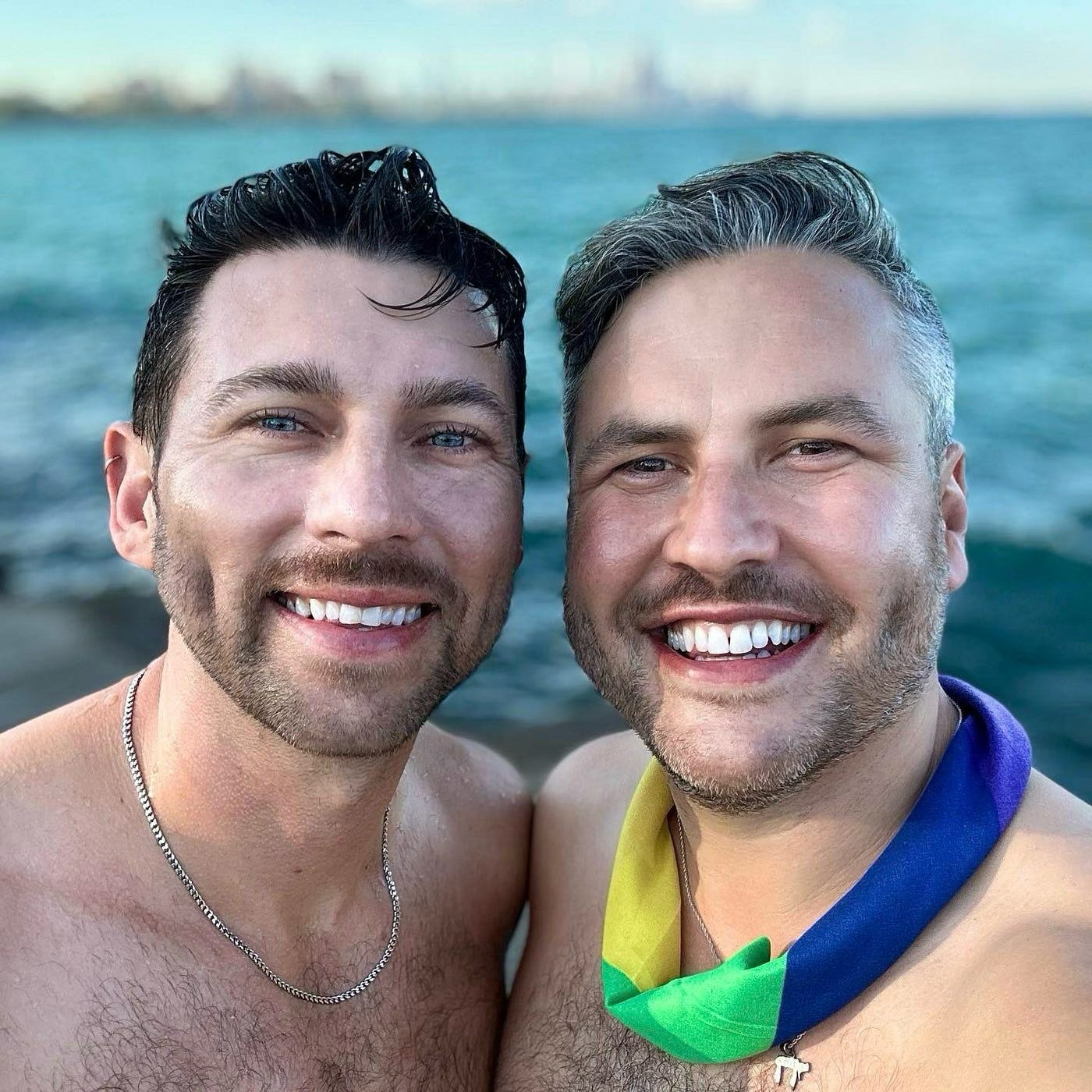
With Nate celebrating Pride and our 8th wedding anniversary, just steps from where we were married on shores of Lake Michigan in Chicago, Illinois.
Alone in the Ghost House
For months after Nate left repeatedly in 2023 and early 2024, I would sit alone in the home that Nate and I had lived together in for almost two years, surrounded by a museum of our memories and artifacts of our shared lives together. Framed photos of us (most of which I had put away in closets), artwork that we collected from around the world, magnets representing every city and place we had visited together, and a world map with pins identifying each stop on our global journeys. Even with Dolly lying on the bed beside me, this experience of being alone — and yet surrounded by the ghost of Nate — was often gut-wrenching. So, in between bouts of calling the Suicide Crisis Lifeline, seeing therapists, and talking with a few close friends, I wrote emails to Nate — often very late at night, largely because I couldn’t sleep and was trying, desperately, in my state of loneliness and fear, to make sense of the nonsensical.
Often, the emails were pleas for Nate to help me take care of Dolly (he eventually offered to, but only if Brian could see her, an offer I quickly declined); expressions of profound pain and loss; memories from our many years together; the latest discovery of Nate’s betrayals and lies documented in credit card statements; and reflections on our lives or the divorce that was barely unfolding, even though Nate had filed it months ago.
In July 2024, I wrote Nate a long email — almost a love letter in disguise — cataloging all the tiny, shimmering domestic rituals I missed. He replied: he missed much of it too, but he felt better outside the relationship and didn’t want to try again. He hoped I’d find joy elsewhere and offered to read anything I wrote about us: “It’s a story that was truly greater and more entertaining than fiction.”
Six months later — in this story’s many twists and turns — we reconciled briefly and withdrew the divorce.
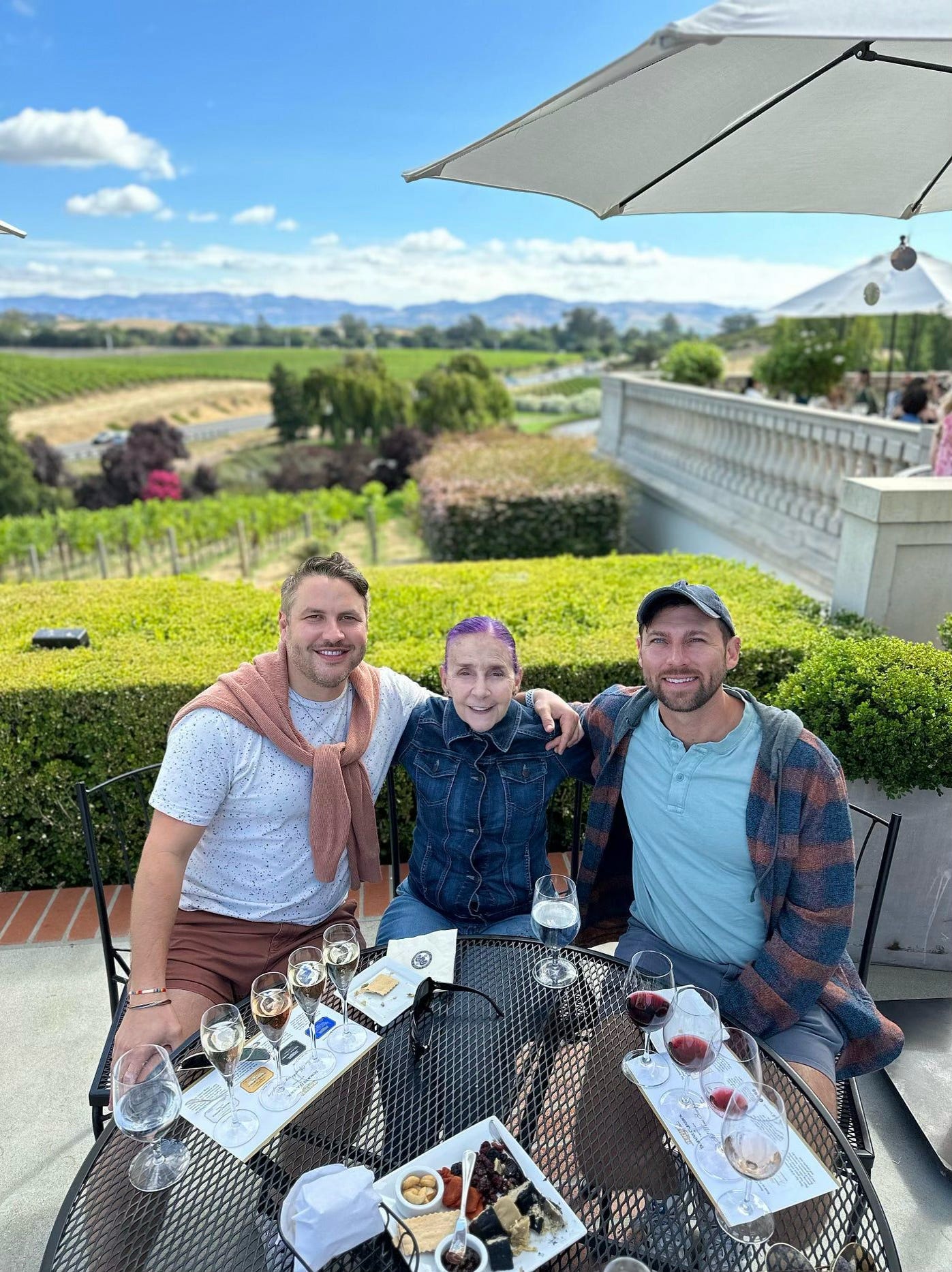
With my mom and Nate during a trip to Napa and Sonoma, CA, in September 2023. By all accounts, we enjoyed our time together, and my mom did too — even though just a few weeks later, Nate started to vanish over and over again. A wine aficionado, my mom was about to celebrate her 81st birthday. She fondly called Nate her “drinking buddy.”
Family
Over the years, the family that I shared with Nate grew and shifted — as we adopted new dogs and lost the dogs we loved, Cooper in 2017 and then Oliver at the very end of 2023. One constant, at least for a long while, was the people. We built a small constellation of chosen family: a few close friends in Boston and New York City who remained long-term, several more in Chicago, and then in LA and Long Beach. Blood family mattered, too: Nate’s parents, his younger brother, his grandparents; my mom, my dad when he was still with us, my brother. We all became deeply intertwined in ways that felt permanent.
In queer life — certainly in mine — belonging and family mean survival. Many of us spend years feeling isolated and alone, unsure if we’ll ever find “that family.” I had one growing up, even after my parents divorced when I was eight. My mom, my older brother, and I moved from New York City to central New Jersey when I was ten, where I finished elementary school, middle school, and then high school. My family was small but real. My brother and I were close until he went to college, my mom was my role model, and I saw my dad monthly for Chinese food before he’d head home to Manhattan. Still, I craved more — more connection, a larger group of people who loved me for who I was and made me feel seen.
I thought I’d found it with Nate and his family.
I met his parents and grandparents and younger brother just months after meeting Nate, when they drove their RV to the New Hampshire–Massachusetts border. After we married, the ties deepened: trips to Michigan — so many I lost count — boating days, stays at his parents’ cabin up north, holidays and board games, long talks about politics and hunting and the economy and history. His dad, Gary, loved World War II and Civil War history. His mom, Susie, cooked vegan food for us. I adored his grandparents — still in their early nineties as I write this. I loved his grandfather’s stories and knack for fixing things; his grandmother baked for us and cracked jokes. We went camping with them. Nate got to know my mom well — we lived near her in Boston while I finished law school. I later moved her and her four dogs across the country to Orange County so we could all be closer in Southern California. We took her to Paris and Cuba and Napa wine country. We went whale watching with my mom many times. Nate’s parents visited California a couple of times; his brother maybe once.
For years, it felt like permanent enmeshment — the good kind. Different as our families were (rural Michigan vs. New York City Jewish; married for 40+ years vs. divorced when I was eight; parents in their 20s when they had kids vs. my parents in their 40s/50s), I felt fully a part of Nate’s. After all, I was married to their son for a decade and with him for nearly two.
That’s part of what makes the end so brutal. Just months after we saw Nate’s parents in Michigan in summer 2023 — and met his new niece — we went to Sonoma and Napa with my mom. Then autumn came and Nate began to vanish. I texted his parents asking for a conversation and support. They refused, only writing vague expressions of support, with his mom telling me to “get yourself on the right track,” whatever that meant. Later that fall, as Nate’s behavior turned erratic and frightening, I reached out again. In late December 2023, when Nate secretly filed for divorce and vanished, I begged for help.
I repeatedly tried to reach Nate’s parents — people I’d loved and known for fifteen years, and who I had just gone boating with in Michigan several months earlier. I told them about my concern for the man I loved, much less for our relationship, which had crumbled in a matter of weeks as a result of the chaos that was escalating dramatically. They offered no help, refused to call me, and Nate’s dad said that Nate’s mom had an “extraordinary intuition” and a “knack” about Nate and therefore knew he was fine, even though I’d spent almost every waking hour with him for 15 years. They wouldn’t tell me where he was. Nate, I later learned, was lying to them about me, about where he was, about everything.
After Nate took property from our home without my consent and I found it at a storage unit, I called to ask for help. His mother screamed, “Who paid for all of this? You didn’t pay for any of it — Nate did.” That wasn’t true, and it wasn’t the point. After that call, I stopped messaging them. Two days later, his father texted — not to check on me, his son-in-law of fifteen years, but to say he would be removing me from the family AT&T plan within “one week” so I could “find my own carrier.”
That was it. The pretense of lifelong “family,” reduced to a billing change.
In February 2024, a few days before my birthday, Nate said that he was going to Michigan for treatment. I texted his younger brother a program suggestion for Nate in Michigan. He never replied; instead, my number was blocked by Nate a day later. Nate had promised to call me on that day, which was my birthday; he didn’t. Minutes after the planned time, he emailed to say email was best from now on because I “bothering” his family (a commitment he would break soon thereafter). I sat in my car in the rain, crying, just steps from my own birthday party. That year’s birthday dinner with my mom and my best friend — who had known Nate and I for almost a decade — felt like a memorial.
In summer 2024, as Nate and I restarted couples therapy (one of several I found and paid for), Nate ghosted the therapist again (he had ghosted our other couple’s therapists in late 2023 and early 2024). I texted his parents once more — after an unexpected package arrived at my door from Brian, using Nate’s former LA address: inside were my mom’s childhood slippers, her birth certificate, Oliver’s cancer bandana, and family photos. Nate had taken those items with other property; now Brian was mailing them back. I asked Nate’s parents to talk; they said that “now is not the best time” and that they “would like to have an open and honest conversation after things have settled.” They never reached out again, and neither did I.
I texted his grandmother once in 2024 to wish his grandfather a happy 90th. She replied with kindness and hoped we could remain friends. Nate later texted: “Thanks for ruining my grandfather’s surprise birthday party.” Another lie. I hadn’t ruined anything.
In losing my spouse, I lost a family. Some supposed friends, too.
Yet many stayed — showing up for late-night calls, couches, and calm amid the storm. For that, and for my mom and my brother, I am endlessly grateful. And I’m resolved to build a new family with people who mean what they say and say what they mean — who don’t lie, disappear, or manipulate; who love me for who I am.
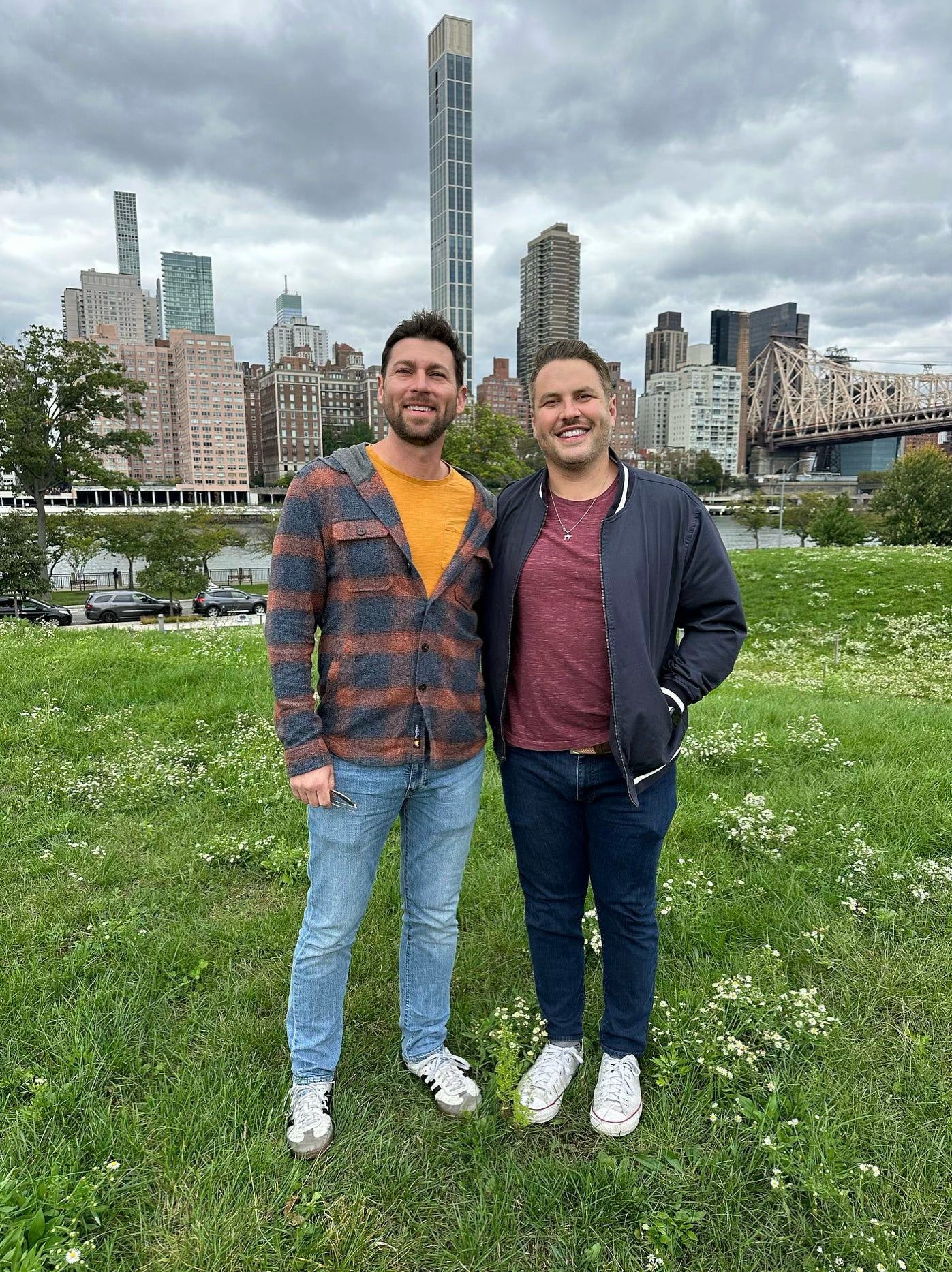
With Nate in Roosevelt Island, New York — where I grew up — in October 2023. It would be one of our last trips together.
Boundaries (and the Years Before)
We didn’t always have great boundaries. In the earliest years, we experimented — together, consensually. Later, when secrecy crept in, I often rationalized, minimized, or tried to fix it.
In Long Beach — before the bigger collapses — came the first 911 call Nate ever made on me. I had discovered he was continuing to hook up with a coworker he’d agreed to stop seeing. I was furious and hurt and grabbed his work laptop to force a conversation I didn’t yet have the tools to hold. He called 911 on me. Officers arrived, talked to us separately outside, listened, and told us there was no crime to address. They left. Nate apologized afterward, and I did too. Therapists later called my behavior that day a form of emotional dysregulation; they also called Nate’s impulsive and destructive use of the police in intimate conflict a form of emotional abuse. We tried to repair in therapy — and wrote rules for our relationship in 2022 — then 2023 arrived and the floor gave out.
By late 2023 into 2025, after explicit agreements made in therapy with Brian, Nate broke every boundary that mattered. Drug use, secret trips, sexual betrayal, moving to D.C. and sharing a lease with Brian while still telling me, in therapy, that he wanted to work on our marriage.
In February 2025, after Nate and I had reconciled, I opened our glove compartment outside of our storage unit in Palm Springs, looking for a Band-Aid for Nate’s cut finger. Instead of a Band-Aid, I found an envelope addressed to Nathan and Brian from a D.C. property manager — a move-in inspection dated September 2024. Nate denied it, then admitted he’d been living with Brian and was still on the lease even as we were moving in together in Palm Springs. My heart sank at the discovery of yet another secret, another betrayal — a feeling I had become accustomed to for years.
Our therapist set a hard boundary: email Brian (copying both of us) to remove yourself from the lease and cease contact. Nate agreed. The next day he told me Brian had texted that he missed him, and Nate replied that he missed Brian too.
A boundary broken, yet again–-this time within twenty-four hours.
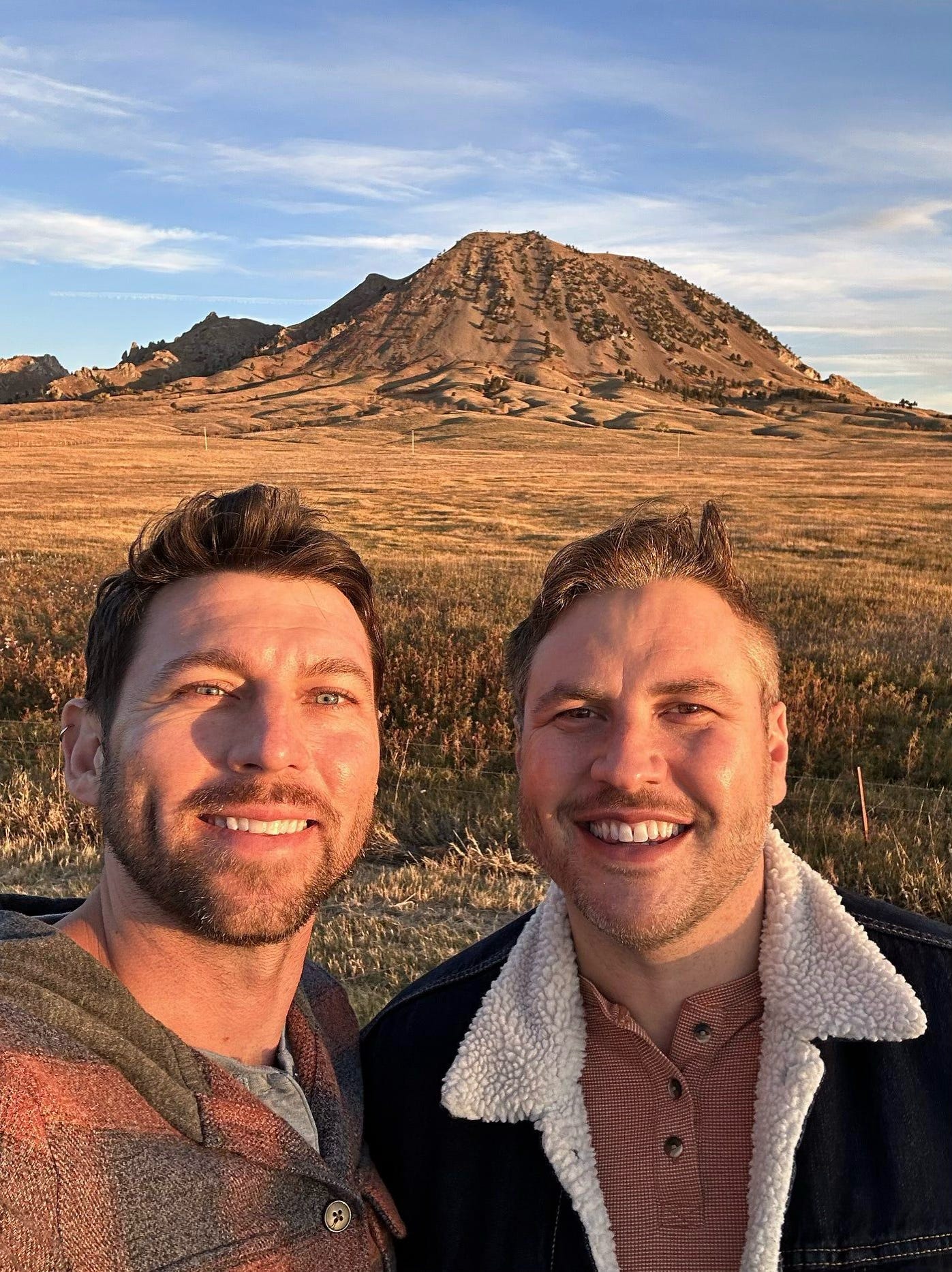
With Nate near Bear Butte, South Dakota to attend a friend’s wedding in October 2023. The butte is considered a place where the Creator communicates with people, where sacred knowledge was imparted, and where spiritual leaders historically sought guidance through vision quests. Looking back, I wish we had sought its guidance — though perhaps it was already too late.
Trauma, in a Body
Trauma turned time viscous. Intrusive thoughts arrived like meteor showers.
In late 2023, I drove from hotel to hotel in Long Beach after Nate told our therapist he was there; I cried in my car outside lobbies where he wasn’t. In early 2024, he said he was climbing a hill in Santa Fe to a meditation retreat, while staying with a “family friend”; my gut knew he was lying. I drove to Palm Springs shortly thereafter and texted him I was there; he said he wasn’t. Technically true — he was just north of the city, in yet another Airbnb. I learned what “crazy-making” feels like — all the disorientation, all the panic, and none of the magic that we once had.
I chased Nate sometimes, and I forgive myself for it. It was a trauma bond — my nervous system bargaining for contact with the person who was hurting me. As a therapist urged, I eventually put my end of the tug of war down, which is easier said than done amid such sustained chaos and betrayal.
The pain, daily trauma, and suicidal ideation often felt unbearable. I could barely sleep or eat at times; it felt like the Earth itself had come apart. Even Nate’s therapist told me he was amazed I could still work through such ongoing trauma and betrayals (the truth was, I was barely functioning).
But somehow, despite the seemingly long odds, I survived. And as my mom reminded me, I persevered.
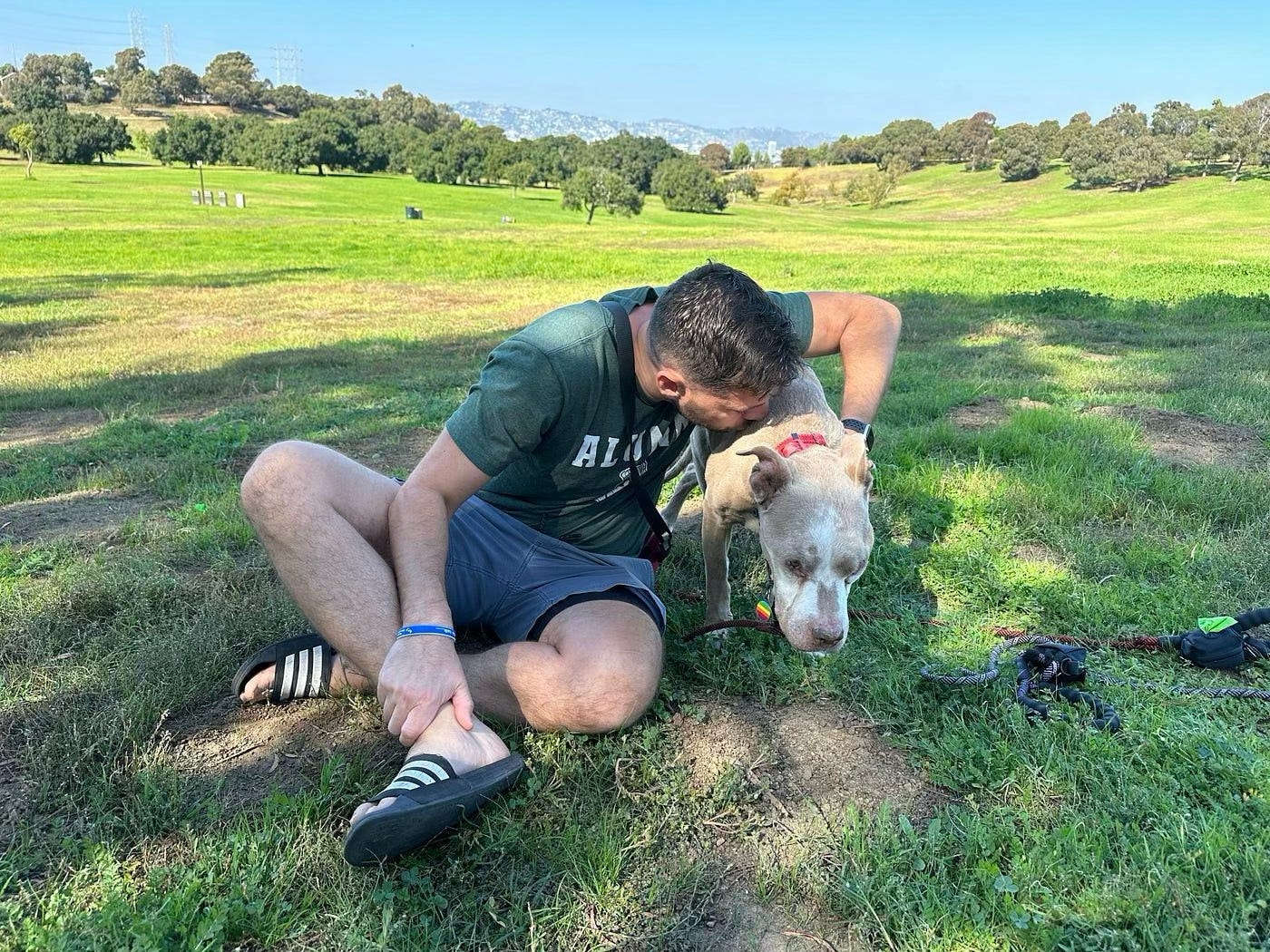
Nate with our beloved dog Oliver in October 2023. It would be one of our final photos with him. He succumbed to cancer, after a long and courageous battle, a few weeks after this photo was taken at his favorite park, near our home in Los Angeles. We loved Oliver so much. I miss him everyday.
The Daytime Sidewalk Incident
One afternoon in early 2024 — broad daylight, not a crisis at midnight — Nate had texted that he’d been admitted to a mental-health program near LA, after repeatedly promising he’d get intensive help. It was a lie — I ultimately counted nearly 100 lies by Nate in just a few months before losing count. The next day he went silent, except to say he “wasn’t feeling well.” Worried, I entered his apartment around noon with his landlord’s permission and found him in a deep sleep. He didn’t wake when I tried, so I left, panicked, afraid he’d call 911 again if he saw me.
Before long he texted; I returned and told him I was very worried and asked him to come with me to a treatment program — I would drive him. He agreed. We ate a snack together and started toward a facility, but it wasn’t open. I kept my voice soft, told him I loved him, rubbed his shoulders, and said we could try again. He had a work call, so we went back to his apartment. I sat beside him on the bed and massaged his feet while he spoke. After the call, he agreed to pack a small bag and come with me.
Outside on the sidewalk, I called several programs; he agreed to do phone assessments and paced near me while I called. That’s when two police officers walked up beside us — lights off, hands near holsters. Without telling me, Nate had texted 911 and claimed he was in danger. He wasn’t; we were talking calmly and had just booked several phone assessments. I watched the switch flip: minutes earlier withdrawn and barely speaking, he suddenly presented as calm and fine, saying I had “burglarized” his apartment. The officers told me to keep my distance — even as they acknowledged he likely needed intensive mental healthcare. I told him I was sad he’d do this, and I walked away shaking, back to Dolly and an empty house — again.
It didn’t happen just once. He called 911 while a county crisis team was already there — shouting “I’m divorcing Jared” and pushing me out the door as I begged him to talk. He called at our storage unit a few days after he left in December 2023 when I tried to return our things home. He called when I found him sitting in our car and he said he “wasn’t feeling well,” even though he was actually driving to LAX after telling me he was heading to Michigan. Each time, the message was the same: I was the problem; he was the endangered one. Each time, officers found no crime, and I went home more rattled, convinced the ordeal would never end.
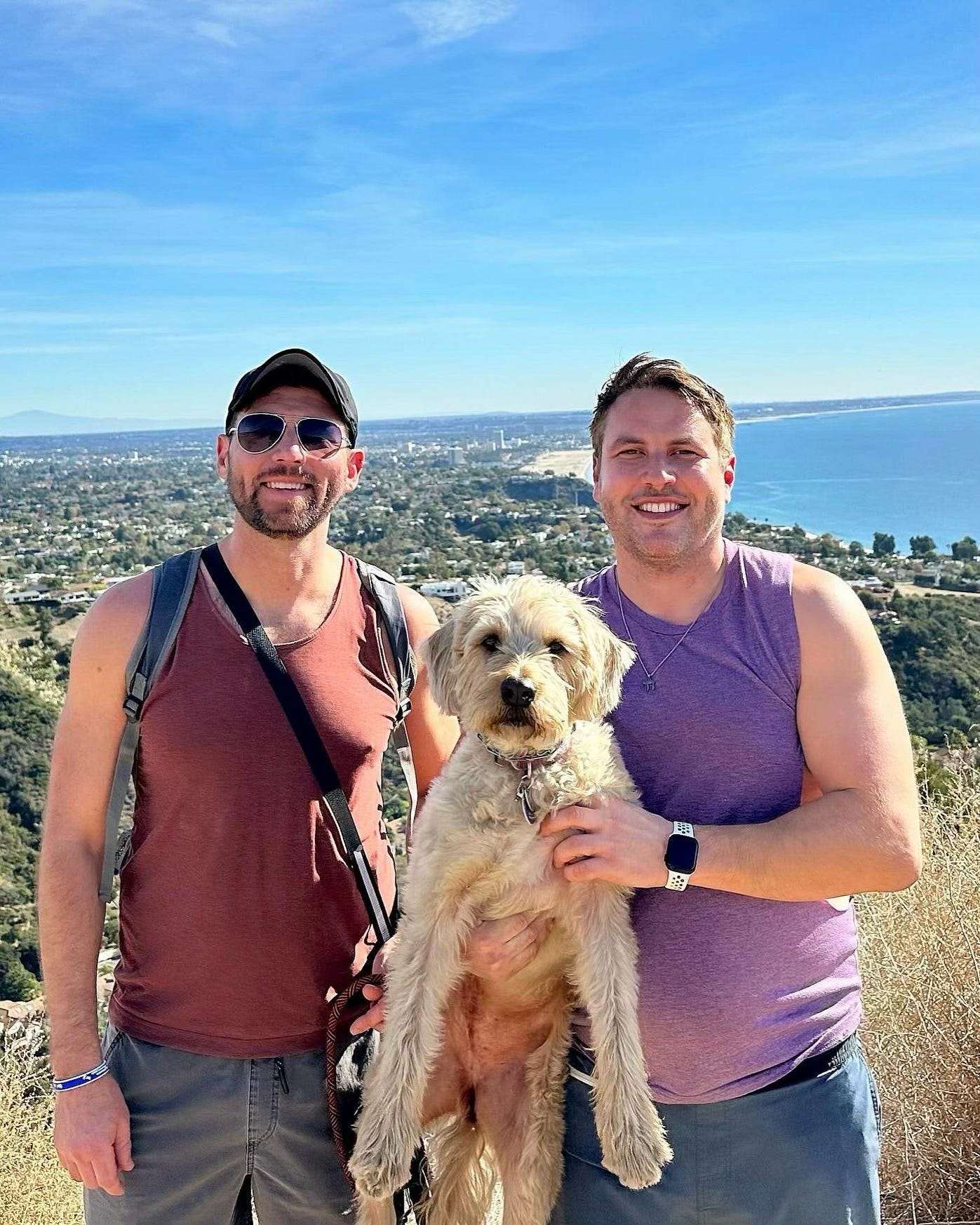
Nate and I hiking with our dog Dolly in mid-December 2023 in Los Angeles. He would secretly file for divorce several days later and leave our home again on December 22nd, this time while I was at the gym.
Betrayal in Slow Motion
By March 2024, Nate and I had been doing couples therapy over Zoom for several weeks. We still weren’t meeting in person — too many reversals, lies, disappearances, and 911 calls — but the temperature had lowered just enough to try a carefully structured visit. We agreed on two simple reasons: finish our taxes together and let Nate see Dolly. It would be the first time we’d seen each other in weeks without police involvement.
He came over. We kept our voices soft, watched a bit of a show, and sat at the kitchen table where we’d spent so many evenings before the secret divorce filing and everything that followed. I asked him — plainly — not to see Brian. He told me he had therapy the next day in the Beverly Hills area with the same therapist I had found for him months earlier. He said he’d go to Long Beach to work in his office, have a few meetings, and then head to therapy.
The car was a new flashpoint. We co-owned two vehicles. Nate had previously taken one, crashed it on a snowboarding trip with Brian, and later traveled with the keys, promising to mail them back, then never did. I’d had to re-key that car. He’d left clothes and shoes in it, forgotten, like so much else. I was afraid to let him drive again — afraid he’d crash it, and just as afraid he’d steer the mile and a half straight to Brian’s. We compromised: Nate could use the SUV, but Brian wouldn’t ride in it. I couldn’t enforce the rule, but it was something — one boundary in a landscape where almost nothing held.
On the couch that night, Nate massaged my shoulders — not the way he used to, but in the exact way Brian did. It felt uncanny, borrowed, wrong. Still, he promised: therapy first, then he’d call me on the way home.
We didn’t finish the taxes. After he left, I kept working while Dolly curled at my feet.
The next day, Nate called from the road, saying he was driving back from Long Beach and might go for a solo run on a hill in West Hollywood before therapy. The story sounded off — vague in all the places he was usually specific. On our car’s GPS, I could see the truth in real time: he wasn’t heading to Beverly Hills or West Hollywood. He was driving straight to Brian’s.
Fight-or-flight surged through me. He’d just told me — again — that he wouldn’t see Brian; that he was going to therapy; that he’d be running alone. All lies. In a panic, I got in our other car and drove the mile and a half to Brian’s place, telling myself I needed to confront the lie, to make reality undeniable. (I see now it was a trauma response inside a system that had already become completely unworkable.)
On a residential street near Brian’s townhome, our SUV rolled toward me. Brian was in the passenger seat, both of them in running clothes as they laughed and smiled.
They had been planning the run together all along — no therapy, no solo anything.
I pulled alongside and asked Nate why he was lying. They reversed down the street and parked, backing the SUV — the car we’d bought together in late 2017 after Cooper died, during my Long Beach City Council run — into Brian’s one-car garage. I parked at the curb and walked up to the open garage. I wasn’t yelling. I wasn’t threatening. I was ten feet away, inside the threshold, asking the simplest question: Why did you lie to me?
Brian snapped first. He dialed 911, telling the operator I was “trespassing,” even though I had already stepped back into the public alley that ran between the townhome and the neighboring property. He wasn’t the owner of the property anyway — he rented a room there. Nate told him to hang up. Eventually he did. No police came. (I was relieved; I’d already endured multiple 911 calls from Nate in the previous months, none of which resulted in charges because there was never a crime — only paranoia, delusion, and escalation.)
Nate and I talked briefly on the sidewalk. Brian joined. Nate minimized everything and said we’d “talk later.” There were no answers to be had. I turned to leave.
Brian followed me and asked if I was “tracking” Nate.
“It’s our car,” I said. “He lied to me.”
Nate drifted back toward the door of the apartment that had once felt safe to me — movie nights, meals, a couch we’d all shared. Now it felt like a stage set for betrayal. I tried to appeal to whatever softness might still exist in Brian: I told him I had empathy for how complicated this must feel; that he clearly cared about Nate; that Nate was struggling; that I was struggling too. I explained what my therapist had named for me — betrayal trauma — and asked Brian to honor his own promise from a few months earlier to step away, to stay out of our dynamic, to stop contacting either of us.
Brian’s face went flat. Then he said the line I will never forget:
“I hurt you. I knew I was hurting you, and I decided to do it anyway.”
My therapist would later call those words textbook sadism: cruel and calculating, with a degree of twisted glee that was breathtaking.
I looked at Nate and asked if he heard what Brian had just said. Nate mumbled that he wanted to “listen to both of you,” vacant, detached — like a person watching his own life from somewhere far away.
Then Brian flipped again, berating me: “You earn no money,” he said absurdly, and complained he’d had to open a new bank account because I’d disputed charges — money Nate had sent him while we were still married, including during their secret snowboarding trips that ended with them crashing our SUV. For the record, I earned double Brian’s salary. He played victim and aggressor in the same breath.
I didn’t yell back. I repeated that he was lying and asked, again, for distance. Nate said almost nothing. They walked inside and slammed the door.
I stood there for a moment, numb. Two people I’d trusted — one my husband and partner of fifteen years — had just turned our shared life into a small, brutal theater.
I drove home to Dolly. Her familiar wagging tail was the only thing that still felt pure. Then I drove to the beach to work out, trying to burn through the panic. I called a close friend from the car, numb but somehow still surviving. That night, I emailed our couples therapist to tell her what had happened. She urged us to stay away from each other again.
Through the GPS, I saw Nate driving our car to Santa Monica, almost certainly with Brian. He parked it in Brian’s garage that night.
The next day, I tried again to talk to Nate. I told him we were done — but what I really wanted to know was why. Why he kept doing this, why he couldn’t stop, why the man I’d loved for fifteen years had become a stranger I couldn’t reason with.
The weekend came, and I was alone again. And the weekends were always the worst, because I knew there was an active betrayal ongoing, that Nate and Brian were probably on yet another trip together, laughing, having sex, and living their best lives while I was alone with Dolly, reeling from the surreal trauma that was unfolding in real-time. I pictured them doing all these things — because I had seen them do it when we were all together, when I had trusted them with my heart — and the movie reel kept playing over and over in my head.
That Saturday morning, I drove into the Hollywood Hills and parked in our car, overlooking the city we once dreamed about conquering together. In 2011, during our first visit to LA, we drove through Mulholland at night, listening to the Drive soundtrack, talking about our future while the city lights shimmered below. Back then, Los Angeles had felt like a promise.
Now, it felt like a graveyard of what once was. I sat there and cried — hard — and in that agony, I wrote a poem. Because it was all I could do: to try to name the pain, to survive the betrayal, to turn the ashes of our dream into words.
The life we’d imagined together had become a waking nightmare. And I was finally beginning to understand that I was the only one still awake inside it.
Losing You
by Jared Milrad
the pain
of losing you
is the art
of finding me
alone on the
last limb
of this fallen tree.
why can I not
teach you
to feel again?
like you did
on the many days
when you held me
under the sparkle
of the sun
I thought we were
forever then.
I long for you
in the morning
and the evening
in the summer
and the winter
in the arriving
and the leaving.
I carry you now
though the weight
of this loss
might be too great
I will never let go
eternity
would not be
too late
to hold you
might we plant
a seed
to grow
our love anew?
With Nate in Menaggio, Italy, in July 2018. After my grueling run for City Council ended in a devastating loss (through a close runoff finish, where I lost by only 400 votes against a well-funded incumbent), we traveled through France and Italy to heal and recover. Visiting Lake Como in northern Italy was perhaps our favorite stop along the way. Serene and peaceful, we were amazed by the 80-year-old grandmas who easily walked by us on high-altitude village staircases, while we gasped for air far behind. It was a beautiful journey, punctuated by lots of red wine and pizza. I was deeply in love with Nate on this trip — more than ever.
The Wedding Song
In the haze of trauma that defined the spring of 2024, my memories blur. Even now, a year and a half later, I can’t pinpoint when exactly this moment happened — but I know it was sometime that March, as the disappearances, betrayals, and lies kept mounting. I still couldn’t break the cycle: searching for Nate, helping him, believing he could get better, trying to repair something that had likely been lost long before.
It was around Nate’s 39th birthday — a milestone he secretly celebrated with Brian and our former friends without telling me, another quiet betrayal. A few days later, Nate said he was driving home to Michigan to stay with his family. I actually felt a small wave of relief. If it was true, maybe he would finally get real help, maybe enter the treatment program he’d promised for months, or at least find some grounding with his parents. More than anything, it meant he wouldn’t be near Brian, whose influence had come to feel corrosive — someone who, I believed deep in my bones, was enabling the very spiral that was consuming him.
Nate invited me over to his apartment before leaving. I brought his wedding ring — the one inscribed with eternal sunshine, the promise we’d made to each other eight years earlier when forever still felt possible. I also brought a few framed photos of us, which had somehow vanished each time I’d given them to him before. Maybe he’d hidden them. Maybe he couldn’t stand to see the man he used to be.
We stood together in that sparse apartment, surrounded by the hollow quiet of what used to be our life. I played Our Song — Open by Rhye — the song our friend had performed at our wedding. I took Nate in my arms, and we danced slowly in that empty room. For a few minutes, time bent back on itself: fifteen years together, now condensed into one fragile moment of remembering.
But even as I held him, Nate felt far away. His eyes were glassy, his body cold, his presence detached. I was hugging a ghost. Still, I tried — through love, through memory, through sheer will — to remind him of who he was, of who we were. To maybe, somehow, call him back to life.
He said he’d start driving to Michigan that evening. It was already nearly six p.m., and I worried about the long, solitary drive, but he said he’d be fine. I hugged him goodbye, told him I loved him, and left. When I got home, I told Dolly that her dad was going home to see his family. I wanted to believe it.
The next morning, I texted him to ask how the trip was going. He said he wasn’t feeling well and was taking a nap. It didn’t sound right. Late that night — around 11 p.m. — I checked the GPS on our car. He wasn’t in Michigan. He was driving toward LAX.
Panic surged. I got in our other car and drove toward the airport, hoping to find him, to understand why he’d lied yet again. When I caught up to him, he was irritated, cold. He said he didn’t want to talk and told me to go home. I refused, at least at first. Looking back, I realize I was acting from pure trauma — grasping for control in a situation where there was none. I thought maybe my presence could stop him from making another destructive choice, from hurting himself — or me — again.
We parked near the airport, and Nate called 911 on me, even as I repeatedly asked him not to. Again.
When the officers arrived, I told them the truth: that I was worried about my husband, that he had recently been diagnosed with a serious mental health condition, that I only wanted to make sure he was safe. They spoke with Nate, who slipped into that same dark performance I’d seen so many times before. He told them he was divorcing me and wanted me to “stay away.” I told the officers, embarrassingly, that we had just been intimate days earlier, that the night before we’d held each other and listened to our wedding song. They didn’t want the details. They said there was no crime, no wrongdoing — just heartbreak, miscommunication, and pain.
I left, because there was nothing else I could do. I sat in our other car and watched Nate drive away.
As I drove home that night, I watched on GPS as Nate, in our car, headed not to the airport — but to Brian’s apartment. Again.
Another lie. Another betrayal.
Another night I drove home alone, numb, trying to make sense of something senseless.
That night I told myself — again — that I had to get out of the cycle. That I had to survive, even if love no longer could. But the truth was, I wasn’t ready to let go yet.
I was still trying to love the ghost of a man who’d already left.
If Only You Would Have Stayed
by Jared Milrad
how many arrows
to the heart
can one man
take
before he falls
to the ground
and surrenders
in place?
how many
wounds
to the soul
can one man
face
before he kneels
before God
and asks for
the pain
to be
erased?
how many days
can one man
pray
that our band
might still
play —
if only
you
would have
stayed?
With Nate in late May 2025 in Santa Barbara, CA, with our dog Dolly and her latest favorite toy. After we reconciled in late 2024 and moved to Palm Springs in February 2025, we took a long drive together from Palm Springs to Santa Barbara for a work event that I had organized. For the first time in years, it felt like old times; that we were a couple once more, with peace and healing ahead of us. We listened to our songs on the way and played with Dolly by the beach. By this point, even though Nate had already left Dolly and I in Palm Springs several times (and lied about her whereabouts in the process) and had promised he would enter a treatment program, part of me still hoped that things could be different. By late June 2025, Nate would be gone yet again — this time indefinitely.
Other Fractures (Spring–Summer 2024)
The betrayals kept multiplying. After I arranged a mental-health assessment at the Portland airport — a decision I’d later regret — Nate told the clinicians that he “was fine,” and then insisted to me that he was “traveling alone.” He said he’d meet me for dinner; minutes later, he said that his “support group” told him not to. So I spent the night alone in a Portland hotel and flew home to care for Dolly. A few days later, after I returned home to LA, he texted that he “would not be home for two weeks” and would “meet” then. My gut said he was lying; airline checks showed he was flying back to LAX the same day.
Against my better judgment, I took Dolly to meet Nate at the airport that day, hoping her presence might soften him. As the crowd thinned, my stomach sank: Brian walked beside Nate, backpack slung. I asked Nate — calmly — why he’d lied and if we could talk. He wouldn’t look at Dolly. He told me he’d “talk later.” While walking through the terminal, Brian wrapped his arms around Nate as if they were a happy couple. When they stopped, Brian smirked, “Why do you keep reopening the wound, dude?” I asked him to stay away from both of us, as he had promised. Nate murmured to Brian that they should “contact security,” though I stood ten feet away with our dog, shaken and alone. I told them I was leaving, which I did. I sat in my car alone with Dolly and went home.
Weeks earlier, at the gym we’d all once frequented, I saw Brian stretching. I asked — calmly — if we could talk. He refused. When I tried again, he started filming me. I asked him to stop. He didn’t. Management later told him he’d violated their anti-harassment policy by filming a member.
In July, a FedEx box arrived from Brian, using Nate’s former LA address as the return. Inside were fragments of my life: my mom’s childhood slippers, her birth certificate, Oliver’s cancer bandana, family photos. After months of begging both of them to stop causing me pain, the box felt like a taunt. I told Nate about this, and he said that he had “forgotten” these items in his apartment and told Brian to mail them back to me. He apologized for doing that, sort of, but I knew everything he said at this point was completely meaningless.
Nate and Brian’s travels continued: Mammoth — again. Palm Springs and Joshua Tree. Portland. San Francisco. D.C. And then the big “retreat”: a seven-day cruise from Seattle to Alaska, booked in Brian’s name, after Nate told me that his “therapist” had advised him to “take a personal retreat.” By then, I had stopped asking for explanations. The answers were always the same — minimize, deny, reverse.
For the record, across those six months in early 2024, Nate called 911 on me five times, and Brian called once (in Nate’s presence). No crimes, no charges. Crisis teams came repeatedly. The man I trusted with my life kept using the blunt instrument of authority to avoid owning his harm. Advocates would later call it emotional abuse.
And the abuse left a scar in me so deep that I still do not know when, or if, it will ever heal.
The Opening
by Jared Milrad
You entered
the quiet rooms of me —
not with force,
but with footsteps
soft enough
to sound like
little promises
on my gentle heart.
I let you in.
Room by room,
I lit the lamps,
unlatched the windows,
opened the drawers
where I keep
the sacred parts of me
no one else sees.
You stayed —
for a time —
moving through me
as if I were home.
And I believed
that I was.
I rearranged my solitude
to make space
for your voice.
I softened the walls
so your name
would echo gently.
Not because I was lonely —
but because I thought
we were building
something sacred.
But now,
I walk these rooms alone.
And even in silence,
they remember you.
There are corners
I no longer enter.
Not out of fear,
but reverence —
for what was
for what is now
and what will,
perhaps,
never return.
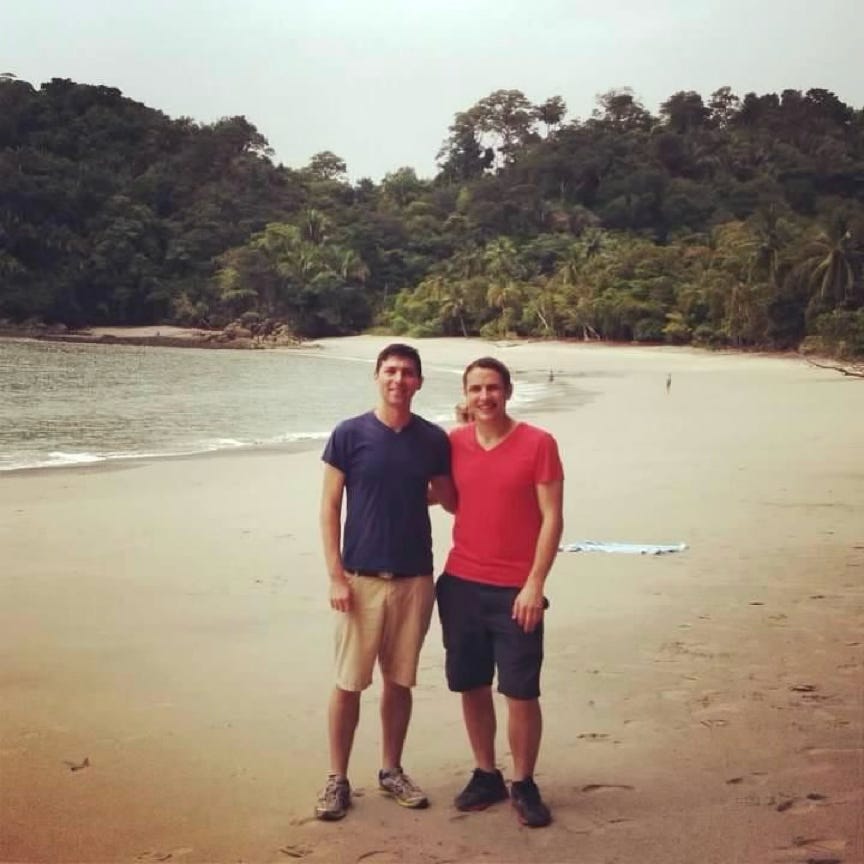
With Nate near Manuel Antonio, Costa Rica in 2014. Though we couldn’t afford to go, we went anyway — and had an incredible time. From visiting the cloud forests in Monteverde to observing Toucans in the jungle to seeing monkeys near the beach in Manuel Antonio, this was our first of many international trips together. I’ll always remember waking up next to Nate, as the waves crashed ashore and two-toed sloths slept in the forests nearby.
A Cautious Thaw
Late 2024 brought a brief thaw. After months of doing couples therapy remotely (while Nate was still in D.C., and I was still living with Dolly in our home in LA, and the divorce remained pending), we spread Oliver’s ashes together in the Sierras, on one of his favorite hikes, with Dolly by our side. We cried, and wished him well on his celestial journey.
In December, we met in New York while I was on a work trip. My mom and stepmom joined for Christmas lights and laughter. We had so many memories in New York City together — including with my family and close friends — and so, in a sense, it felt like old times.
Over a drink in Manhattan, Nate said that our marriage had been the one stabilizing force in his life, and he acknowledged that he had been “an unreliable narrator” for a year or more. I believed him, and felt that he was getting better and wanted to heal.
A few weeks later, almost a year to the day after Nate had filed it, we withdrew the divorce and planned a reset in Palm Springs, hoping that it would be peaceful place to heal and reconnect after a year of chaos and trauma. We moved together there in February 2025, just after celebrating my birthday with a close friend and my mom in LA.
For a few brief weeks, as we settled into our new home, serenity, healing, and a life with the man I loved more than anything (who had also hurt me profoundly), felt somehow possible.
Or at least I thought it was — until the same cycle begun anew.
With Nate near Malibu, California, during one of our first trips to Southern California, circa 2011. We both loved the state and talked about living there for years. In August 2015, just weeks after our wedding, we made it happen.
The Stop
by Jared Milrad
There was no storm.
No slammed door.
No final word
to mark the end.
Only a quiet morning
where I forgot,
for a moment,
to reach toward absence.
And in that stillness —
I remembered myself.
I smoothed the sheets
without imagining your shape.
I lit a candle
for no one.
I stood in the hush
and didn’t ask
if I was still worth returning to.
I stopped
waiting.
Not because you came back
to glue together
the shattered glass
of the home
you broke —
but because
I couldn’t live
at the jagged edge
of maybe
any longer.
Because hope,
when starved too long,
becomes hunger.
And I was aching
for something
you no longer offered.
So I set down the wanting.
I fed the quiet.
I opened the windows
for air,
not for answers.
And I whispered
to the light:
You may never come.
But I’m here now.
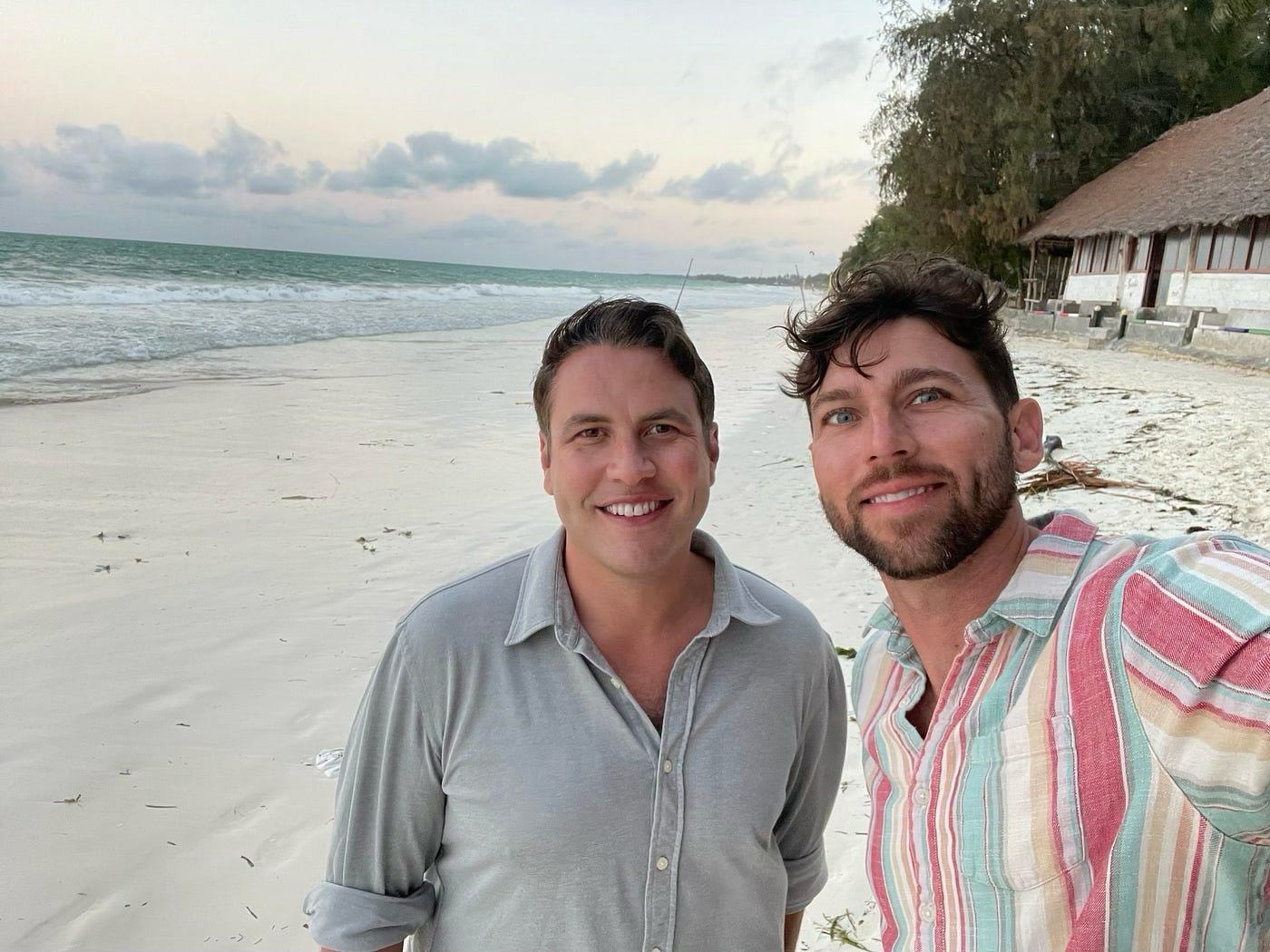
With Nate on the beach in Paje, Zanzibar, Tanzania in September 2021. On our trip to East Africa, we saw mountain gorillas and chimpanzees in Uganda, and extraordinary wildlife in both Uganda and Tanzania. I cherished these evenings walks on the beach with Nate, as the high tide returned and the moon lit our path ahead. It would be one of my favorite trips that we took together.
The Relapses
After we moved to Palm Springs in early 2025 to start over — near my mom, closer to quiet — Nate left again. The first excuse came in early March, when he said he wanted to celebrate his 40th birthday with his family in Michigan — just a few days before the day itself. I told him I was disappointed; I’d hoped we could celebrate together, that his 40th might be a chance for us to heal after so much pain. Only days earlier, he’d said he wanted to mark it in Palm Springs with my mom and me. I told him I didn’t want to care for Dolly alone — again.
Once Nate was in Michigan (supposedly, at least), the cycle began all over again. He said he needed to help his parents. Then he was in a PTSD clinic. Then an outpatient program. Then he turned off location sharing. Then he appeared in D.C. Then Chicago.
Each departure followed a difficult therapy session about Brian.
Each felt urgent. Non-negotiable. Predictable.
I tried not to chase this time — only to observe each sudden departure, each lie, each vanishing act.
In April, Nate returned briefly after I suggested we go to Coachella together for the first time. We danced and sang along, and Nate even said it felt “nice to be sober.” After the festival, we walked hand in hand through our new neighborhood in Palm Springs. He said it felt peaceful there. Restorative. We took Dolly to the park, watched her sprint across the grass, tail high and tongue out, bounding back toward us with joy. For a moment, it felt like old times. I thought, maybe, we could make it through.
Less than two weeks later, he was gone again.
He said he was in Michigan to help his parents “remove a tree that had fallen” on their home, but then I learned that he was in Chicago — and later, D.C. — seeing Brian. Around that time, Nate admitted he had an addiction to drugs and sex. He said he could “never imagine being sober.” Then he said he was entering an outpatient program in western Michigan. Then that he wasn’t. He confessed to using Molly, cocaine, and ketamine — some of it with Brian — then minimized it, then denied it altogether. He admitted sexual betrayals with other men in Chicago, then retracted them, then said they were “just massages.” And all the while, he was continuing to take medications on a self-directed basis, even after promising that he wouldn’t.
The reversals came like a metronome of chaos — almost comical, if they hadn’t been so ruinous.
Nate returned a few more times, but by then, I had begun to imagine a future without him. The chaos was exhausting, and after sacrificing so much, I refused to lose another year to his new version of normal. Nate wasn’t the man I had married in any enduring way. He showed little affection, often distant and dull-eyed, his energy hollow. On some days, he stayed in bed and said he wasn’t feeling well. I massaged his shoulders, and futilely urged him to get consistent help.
He saw a therapist in person in Palm Springs, who once suggested Nate should “take his husband out on a date.” We did. Once, at a small restaurant downtown, it almost felt like us again — until, out of nowhere, Nate asked if I’d thought about dating anyone else.
The fragmentation of the man I loved was now complete. And I had all but stopped trying to change him.
In late June, we took a hike in Idyllwild with Dolly. I told him I was done — after he again defended the five 911 calls he’d made on me in the past year. The next morning, as expected, he said he was flying to Chicago for an outpatient program I knew he’d never attend. He packed quickly, said he’d “talk later,” and left.
Our couples therapist had urged him to attend a residential dual-diagnosis treatment program, even suggesting several options in Palm Springs and beyond. He’d told Nate not to disappear again, not to lie, not to delay.
But once again, Nate wasn’t going to do any of those things. He was going to vanish — and do whatever he wanted — even if it shattered me, when I couldn’t be shattered anymore.
Sure enough, he turned up in Chicago at an Airbnb just blocks from where we were married ten years earlier, near the home we once shared, where we had planned a lifetime together. A few months later, Nate said he had moved to D.C. — again.
Somehow, I didn’t cry the day he left for the last time, though I would cry in the months that followed.
Most of the time I just felt the hollow where hope had lived.
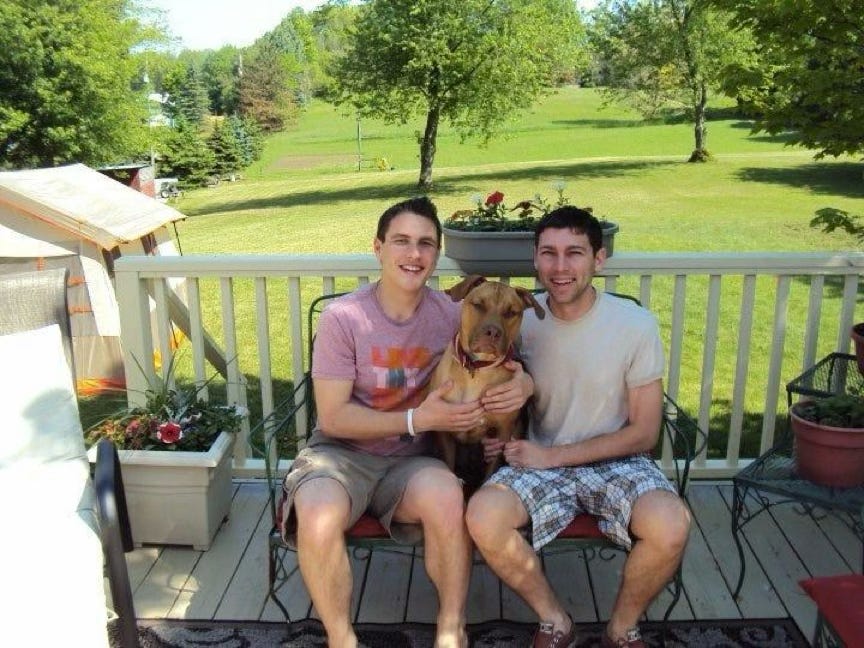
With our beloved dog Cooper in the backyard of Nate’s childhood home, circa 2010. I loved watching Cooper chase Nate’s parent’s dog, Stanley, during our visits to Michigan. It felt like home, and I felt like I was building the family I had always wanted.
The Waiting
by Jared Milrad
It begins small —
a pause
between the breath
and your name,
a space where
I imagine
your voice
might still arrive.
I water the plants.
I feed the dog.
I open the windows
just enough
for the air
to feel like hope.
Each day
adds a layer
to the silence,
until even the walls
start to wonder
if they were meant
to hold someone
who isn’t coming back.
I tell myself
you’re healing,
searching,
on your way —
but the clock
doesn’t flinch.
The sky doesn’t bend.
The stars never ask
if I’m still
waiting.
And I am.
But I am also
cracking.
There’s a kind of grief
that doesn’t come
with answers —
only time,
and the soft breaking
of a heart
held open
too long.
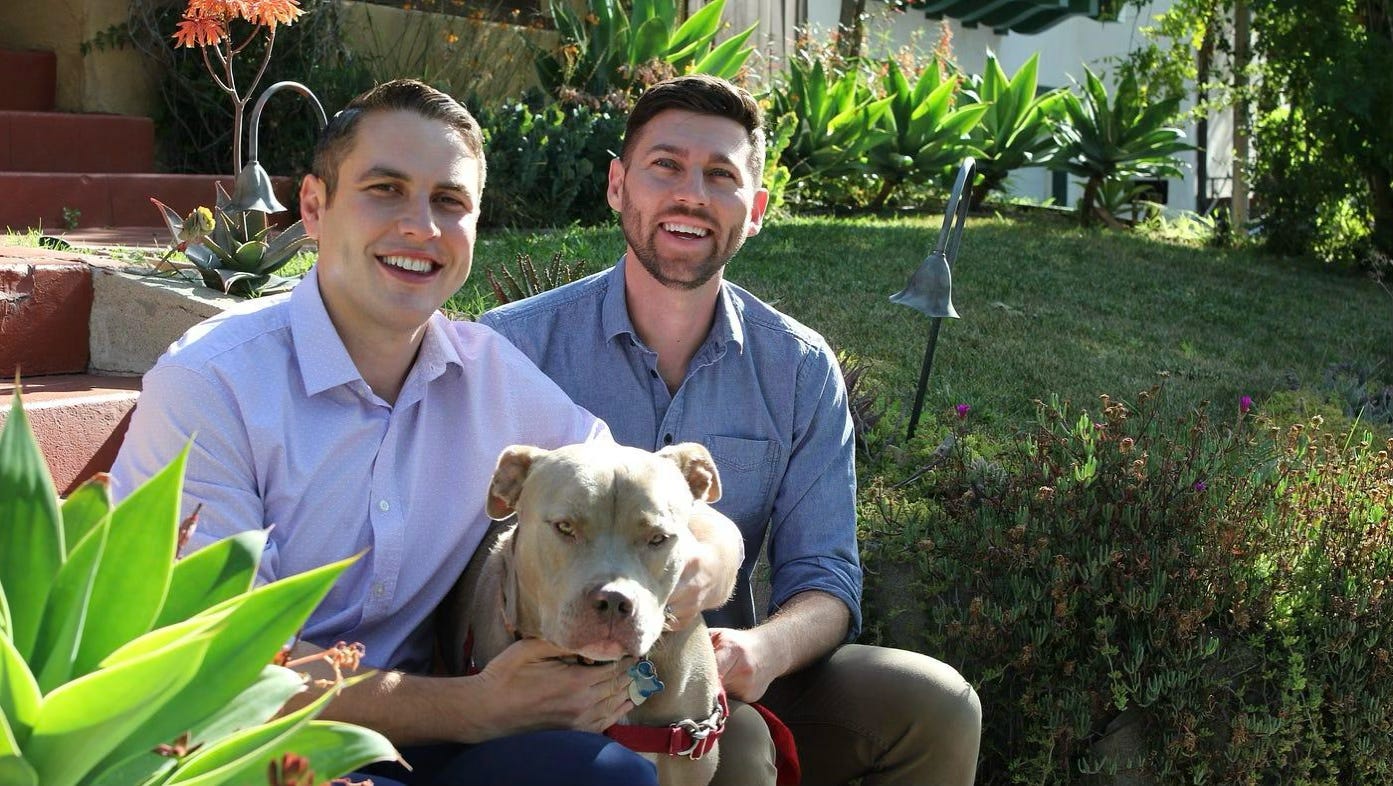
With Nate and our dog Oliver in 2018 in Long Beach, CA, shortly after we adopted him in Los Angeles. We adopted Oliver as a 5 year old pit bull who had been in and out of shelters and various homes for years. Oliver’s adoption fee was only $25. He came to us with a slew of health issues that would cost far more than that, but he was worth every penny. Even though we lost him to cancer far too soon, we loved him more than anything and cherished every moment with him. He loved every person he met — especially if they had food.
Creativity and Survival
Across nearly two decades with Nate — especially the first fifteen years — we shared creativity. In Chicago, I studied improv and sketch at The Second City; Nate came to shows. After we moved to LA in 2015, I made my first projects. Nate helped workshop scripts and even acted in a short film based on us — ironically titled Marriage, about a couple that reconciles after experiencing a cousin’s wedding ceremony. We made a few sci-fi shorts together; he joked that he retired from acting after that one performance. He read lines for my auditions, came to my acting classes, and sang songs with me at home, including ones we wrote together. Nate’s go-to on the guitar was a particularly salacious song by Tenacious D. I laughed every time he played it.
Losing the marriage meant losing that creative partner — and best friend — who was always in my corner. And yet creativity kept me alive.
As was the case after my dad passed away in 2015, poetry was often the only thing that helped me survive for years during Nate’s repeated absences. I published two books during that time — If Only You Had Stayed (2024) and The Love You Left Behind (2025). As I write this, I’m alsopreparing to release my first EP, The Shape of Missing, recorded in the summer of 2025 — songs and interludes that carry grief, loss, despair, and also the small, stubborn hope that keeps breaking through.

With Nate in Petra, Jordan in June 2023. After traveling to Tel-Aviv, Israel for Pride (where we met up with Brian), we decided to take a bus trip through Southern Jordan and onto to the ancient city of Petra. Our visit was complete with keffiyehs that our tour guide encouraged us to wear and eye makeup to match. Walking around Petra, we even found a few stray puppies that I *almost* convinced Nate to take home with us. It would be our last international trip together.
In This Mighty Hour
by Jared Milrad
I did not arrive
with triumph.
There was no anthem,
no banner of survival
unfurled in the wind
from the mountains
that we climbed together.
Just my feet —
on this floor,
in this hour.
Just breath,
steady and mine.
Here
is not what I imagined
when I pictured freedom.
It is quieter.
It smells like eucalyptus
and dust.
It tastes like tea
gone cold
but still good.
There are echoes here —
your name sometimes,
the laugh of a life
we almost lived.
But they do not own me.
I speak
without waiting.
I rise
without searching
the tired moon
for a sign.
I close the door,
and it means
only what it means.
This is not healing
like sunlight
through stained glass.
This is healing
like desert soil remembering
how to bloom
without rain.
And I am here now.
No longer waiting.
No longer asking.
Just here.
In this mighty hour.
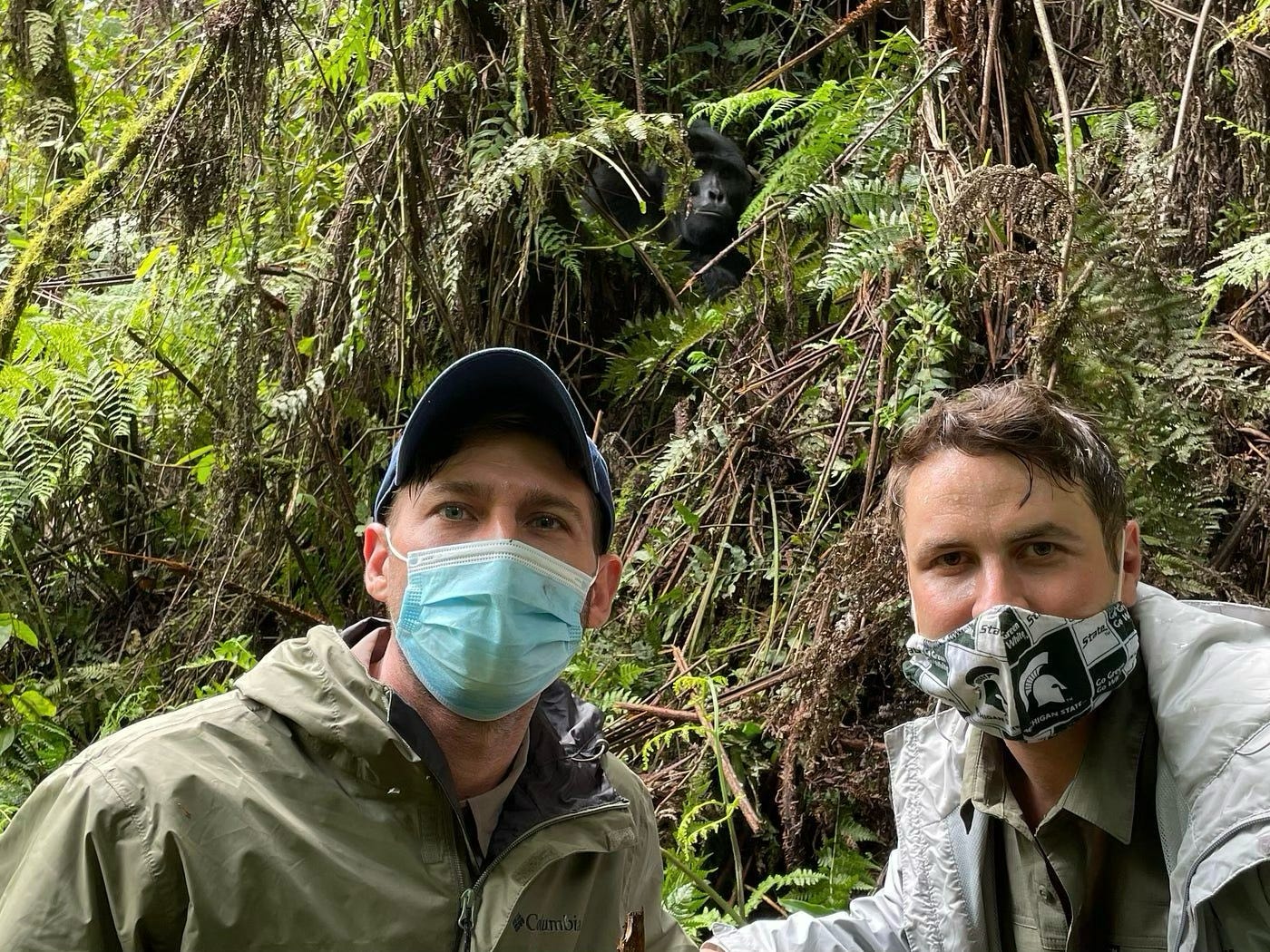
With my husband and a mountain gorilla (far back) spotted in Bwindi Impenetrable Forest in western Uganda in September 2021. We had to wear masks to protect the gorillas from potential COVID exposures. It was quite the trek getting to see them in rough terrain, and it was one I’ll never forget.
The Fever and The Quiet
Palm Springs in summer taught me a different kind of heat.
Locals said 115° was “mild.” It didn’t feel that way.
And yet, inside me, a fever broke.
Instead of flying to Hawaii with Nate for our tenth anniversary — the trip I had planned months before he left, and after he ghosted again on the day itself, despite promising to call — I booked a solo ticket to Portugal. Lisbon’s hills, Sintra’s stone castles, the salt air of a surf town, a sunset sail with strangers from a gay hotel, long quiet dinners alone.
I wasn’t lonely.
I was remembering who Jared was — by himself.
After vanishing several more times, Nate FaceTimed me while I was in Lisbon.
“Where are you?” he asked.
“Lisbon,” I said.
He wanted to know why — and if I was with anyone. I wasn’t. My friend was watching Dolly in Palm Springs. Nate said he was in Chicago, in yet another Airbnb, but hadn’t started the outpatient program yet. “Next week,” he said — like always.
If it was true, none of it surprised me. By that point, we had lived nearly two years in double rents, multiple leases, and temporary rooms — each address another ghost of the life we’d built.
On that trip, a message appeared on a dating app — from someone living not far from Palm Springs. Mostly vegan. Animal-loving. Service-minded. Kind. Steady. We started talking, and didn’t stop. I felt the early click of a trustworthy love — the kind I used to feel with Nate, but without the ache of uncertainty.
When I came home, I dove back into art to metabolize grief: writing, recording music, preparing to release my first EP; finishing another poetry collection; developing a new short film. I spent more time with my mom and with Dolly. The house felt lighter — truer — with new laughter in the rooms and two rescue dogs who quickly became Dolly’s best friends.
In early September 2025, I filed for legal separation from Nate. We were barely in contact by then. I had stopped reaching out, though every week or so he’d text out of the blue — Can we talk tomorrow? — then ghost again, even after setting a time.
A few days after I filed, on one of our many fractured FaceTime calls, Nate cried and then coldly said, “We should just get divorced.” I told him I had already filed for separation. “Why didn’t you file for divorce?”, he asked casually. A fair question. Some small corner of me still imagined reconciliation, even as I knew it wasn’t possible, because there was no one to reconcile with.
I initiated settlement talks — again — and we agreed to forgo lawyers. As before, they dissolved into reversals. Nate would agree to multiple terms after a meeting with me — and then rescind them entirely.
In early October 2025, after feeling exhausted from Nate’s ongoing cycles of abandonment, dishonesty, disappearances, and reversals — and finally accepting that I was the only one still in the marriage— I amended the petition from separation to divorce.
Facing reality, at last, hurt far less than avoiding it.
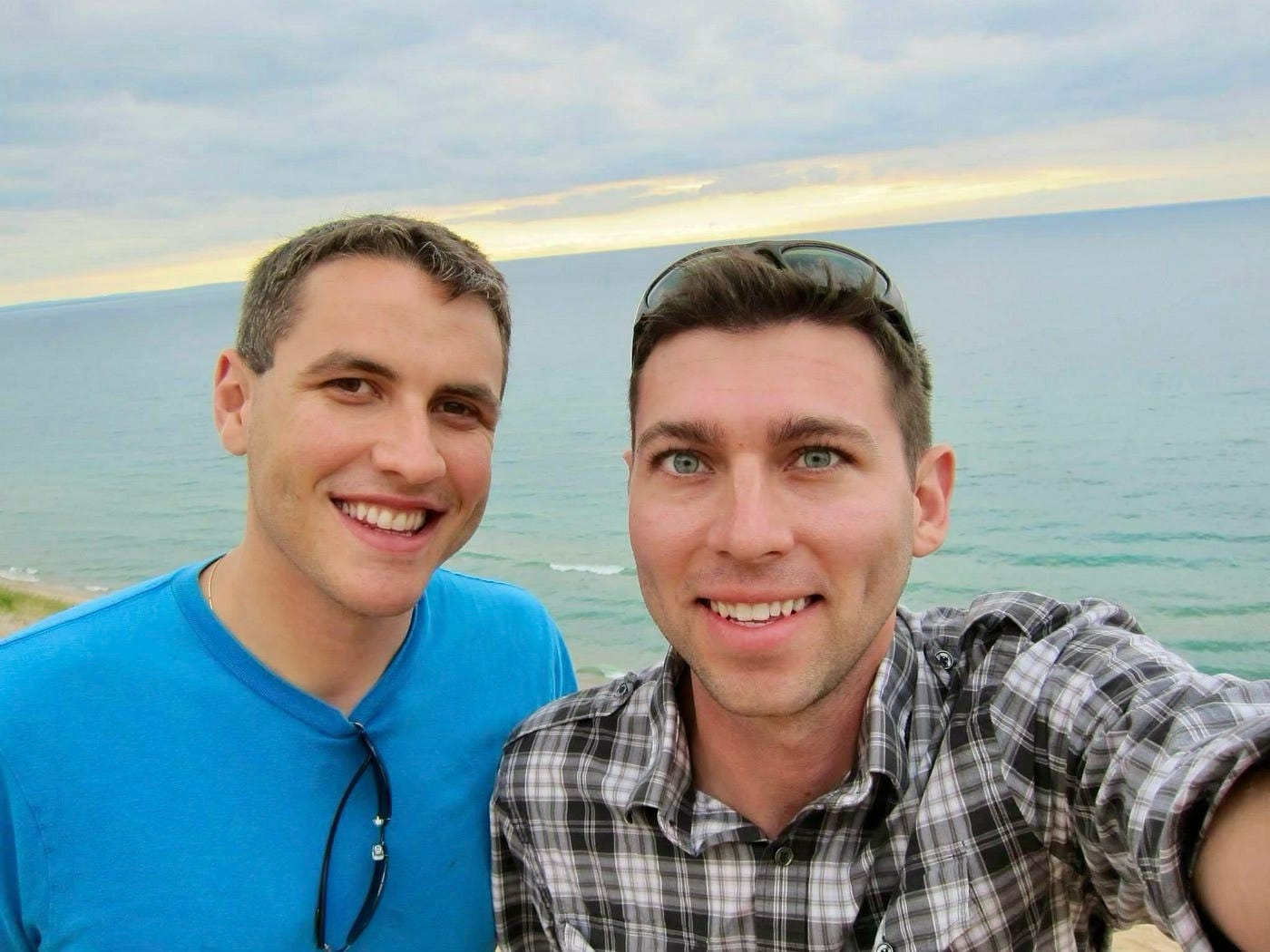
With Nate at the Sleeping Bear Dunes National Lakeshore in Michigan, circa 2010. Though we both often poked fun at Nate’s home state, I loved exploring it with him — and to me, Michigan will always be associated with the Michigander I fell in love and married. Just like Nate, Michigan is quite complicated — and beautiful.
The Quiet Rage
by Jared Milrad
I do not wail,
though the lonesome sky
inside me
has split open.
I do not curse your name,
though the wind still carries it
through the hollows
you left behind.
Instead,
I sit among the ashes
of what we built —
palms open,
throat raw,
watching smoke
rise from stones
you once warmed
with your steady hands.
You —
who held me
like a gardener
tending to the
audacious hope
of a tender soil —
have become
the one who left me
without harvesting
the love we grew.
There was a time
you would have wept
to see me breaking.
A time when your hands
knew how to hold
what mattered.
But now,
your absence moves
like dust —
settling on everything,
refusing to leave,
refusing to stay.
And I am left
with this quiet rage —
ancient as bone,
burning beneath skin
that still remembers
your touch.
I try to name it
lesson.
I try to call it
release.
But the truth is,
it is fire
that will not turn to light.
How could you
wander within
the open fields of me
and still
walk away?
I do not rage
like thunder.
I rage
like stone —
etched with
the name
of the man
you should
have been.
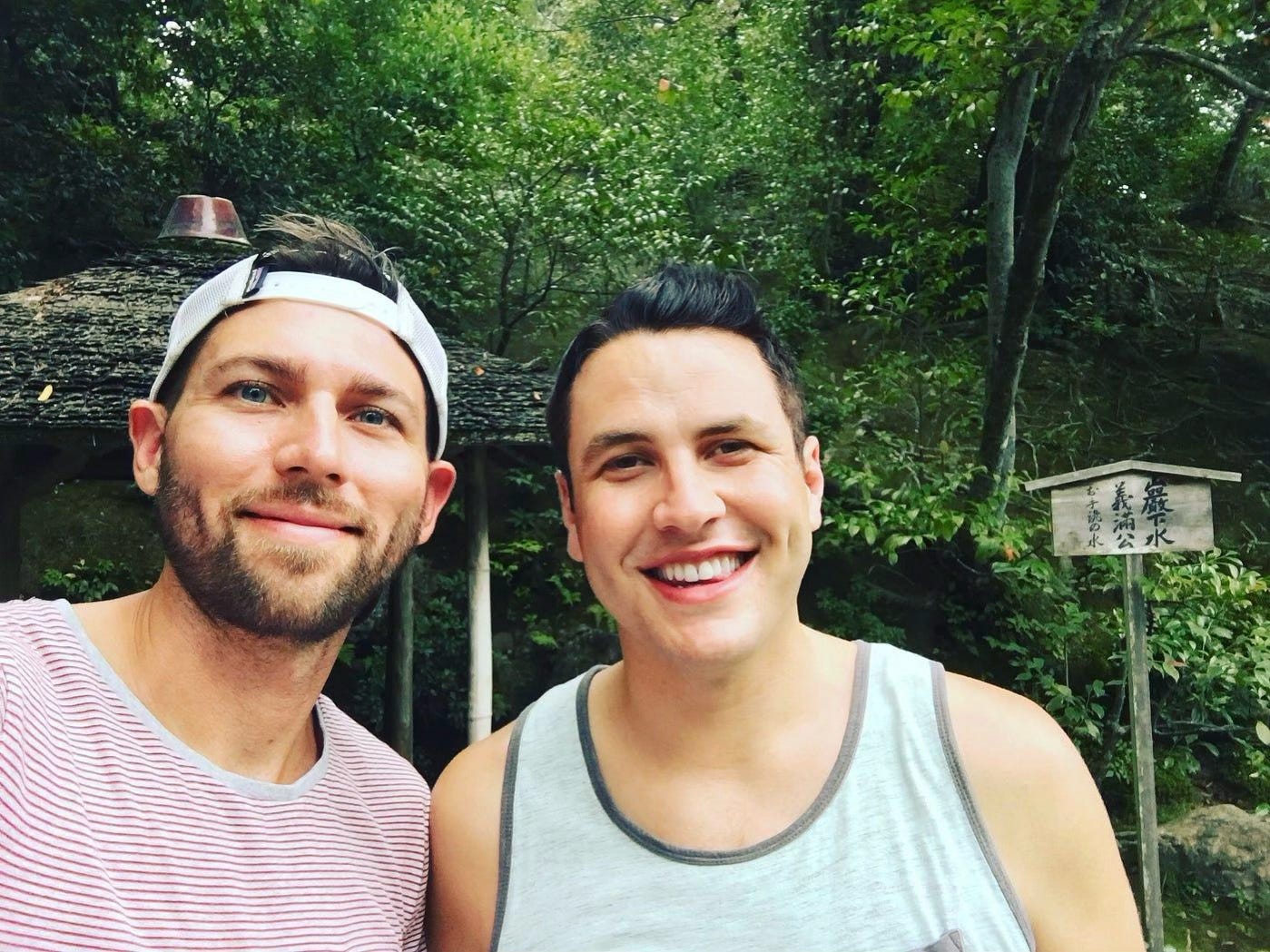
With Nate in Kyoto, Japan, in September 2016. Nate had a work trip to Japan that Fall, and I tagged along. We visited Osaka, Kyoto, and Tokyo along the way, and particularly enjoyed eating vegan food at the Buddhist temples in Kyoto and relaxing in the onsens in Tokyo. Nate once left his cell phone in a taxi in Kyoto — and the taxi driver brought it back less than an hour later, apologizing profusely. We were struck by the kindness of the Japanese people and vowed to return one day.
The Beach and the Crashing Waves
In August 2023 — just before my relationship with Nate reached an unprecedented level of chaos and turmoil — I met with a personal trainer at the gym that Nate, Brian, and I had been using for over a year. The gym was only about a fifteen-minute walk from our home in Los Angeles.
His name was Cameron, and we connected instantly. I had requested a trainer familiar with plant-based nutrition, and even though I had never worked with one before, I was ready. Fitness had always been part of my life — and part of my relationship with Nate. We had worked out together since the very beginning, almost fifteen years earlier. It had been a shared ritual, one of the few constants we still had.
But I didn’t realize then that Cameron would become far more than a trainer. He would become a lifeline.
From our first sessions, he believed in me — my strength, my resilience, my will to heal — even when I didn’t. Week after week, as my marriage began to crumble and the betrayals multiplied, Cameron pushed me to keep going. To breathe through it. To show up. And in doing so, he helped me do far more than rebuild my body; he helped me begin to rebuild my spirit.
Over the next two years, we talked about everything: love, loss, faith, resilience, masculinity, vulnerability, and what it really means to be strong. When I was deep in trauma — disoriented, dissociating, barely sleeping — Cameron became a grounding presence. He saw me when I could barely see myself.
There were moments in those months that I’ll never forget. One night at the gym, during one of my lowest points in early 2024, Cameron took me outside to the upstairs patio. I told him how broken I felt, how I didn’t know if I could keep going. He listened quietly, then cried with me. He told me that my life still mattered — that I was stronger than what had happened to me, stronger than the betrayal, stronger than the pain. That I was worth staying for. His words, and his faith in me, may very well have saved my life.
By mid-2024, we started training at Manhattan Beach, shifting our sessions from gym walls to open air and saltwater. Each week, I’d drive thirty minutes from Culver City to meet him. We’d run two miles along the shore — sometimes at sunset, sometimes in the cold rain — and talk about everything unraveling: Nate’s disappearances, the lies, the PTSD that had settled into my bones, and the love and longing that still lingered there too. I’d often arrive raw from another heartbreak, another deception, another sleepless night.
But the beach gave me something sacred: rhythm, movement, perspective.
One winter evening, under a slate-gray sky, we ran to the end of a long pier as waves crashed violently beneath us. I told Cameron how empty I felt — how my marriage had dissolved, how the person I loved most had become unrecognizable. The wind howled, salt stung my lips, and Cameron placed his hand on my shoulder.
“Your feelings are like the waves,” he said softly. “You can’t stop them. You just have to let them move through you. You are the water. Let it flow.”
That moment stayed with me. It was the beginning of understanding that I didn’t have to fight every emotion, or hold on so tightly to what was gone. I could let it pass through. I could let go.
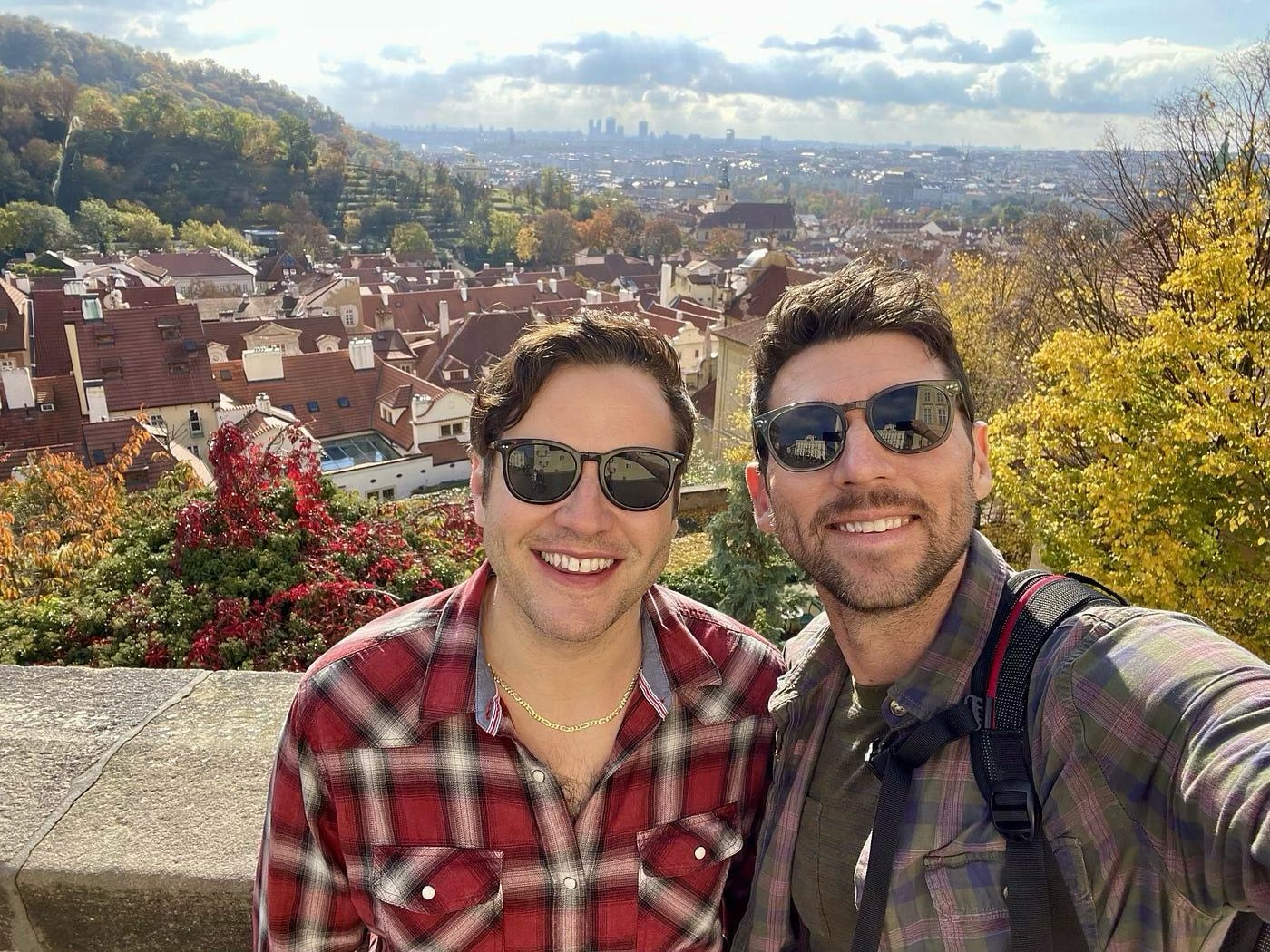
With Nate in Prague, Czech Republic in October 2022. Nate had a work conference there, and I was able to tag along. We had a magical time exploring this enchanting, romantic, and ancient city — even though the hike to reach a castle where we took this photo was a bit exhausting.
When I reconciled with Nate in early 2025 and moved from Los Angeles to Palm Springs, Cameron remained a constant. Even from a distance, he was a source of strength and sanity. I joined a new gym — the one Nate had once suggested — and continued our weekly sessions over FaceTime and visits.
While Nate disappeared again and again — saying he was in Michigan, then secretly in D.C. or Chicago or elsewhere— Cameron kept me steady. He reminded me that I couldn’t control Nate’s chaos, but I could control my own healing.
Week by week, set by set, I began to feel myself again. I grew stronger, physically and emotionally. I began to believe that the body could teach the heart how to recover — that endurance in motion could translate to endurance in grief.
By late 2025, as the divorce neared finalization, I realized that my training with Cameron had become something sacred. It wasn’t just about fitness anymore. It was about survival, transformation, and returning to myself.
Through every rep, every run, every crash of the ocean against the shore, I learned to inhabit my own body again. To feel power not in control, but in surrender.
The lessons of the beach became the lessons of healing:
To let the waves come.
To let them break.
And to rise again — whole, salt-stung, and alive.

In Amboise, France at our best friend’s wedding in June 2018. After my exhausting run for City Council back home, this trip was a welcome respite, and our friend’s wedding in a castle, in a small French village, was magical and unforgettable. I also felt closer than ever to Nate, and cherished every moment with him. After the wedding, we watched fireworks and danced until 4am. Our friend joked that several of the wedding guests asked if we were eligible bachelors — but we were very much married and in love.
I Remember You
by Jared Milrad
I remember you —
your eyes so blue,
your heart so full,
your touch a warm blanket
waiting for me.
With you, I learned
if this love
might hold,
I would no longer
be alone.
I tried with all my might
to keep you in the light;
nothing more I could ever want —
but love alone
cannot stop
darkness
on the march.
Oh, to see your soaring sun
sink beneath the sky
broke my heart
again and again.
Now I must let
the loss of you
play its part.
Sometimes I wonder
when we shall meet again.
If the earth slips
a bit on her plane,
perhaps time and space
will erase the pain
from this weary soul —
and heal the deep scar
left by the first man
I ever truly loved.
For now, I walk beneath the moon,
gracefully marking each step we took together,
and marvel at the millions
of fragile moments
when my heartbeat
beat with hope
next to yours.
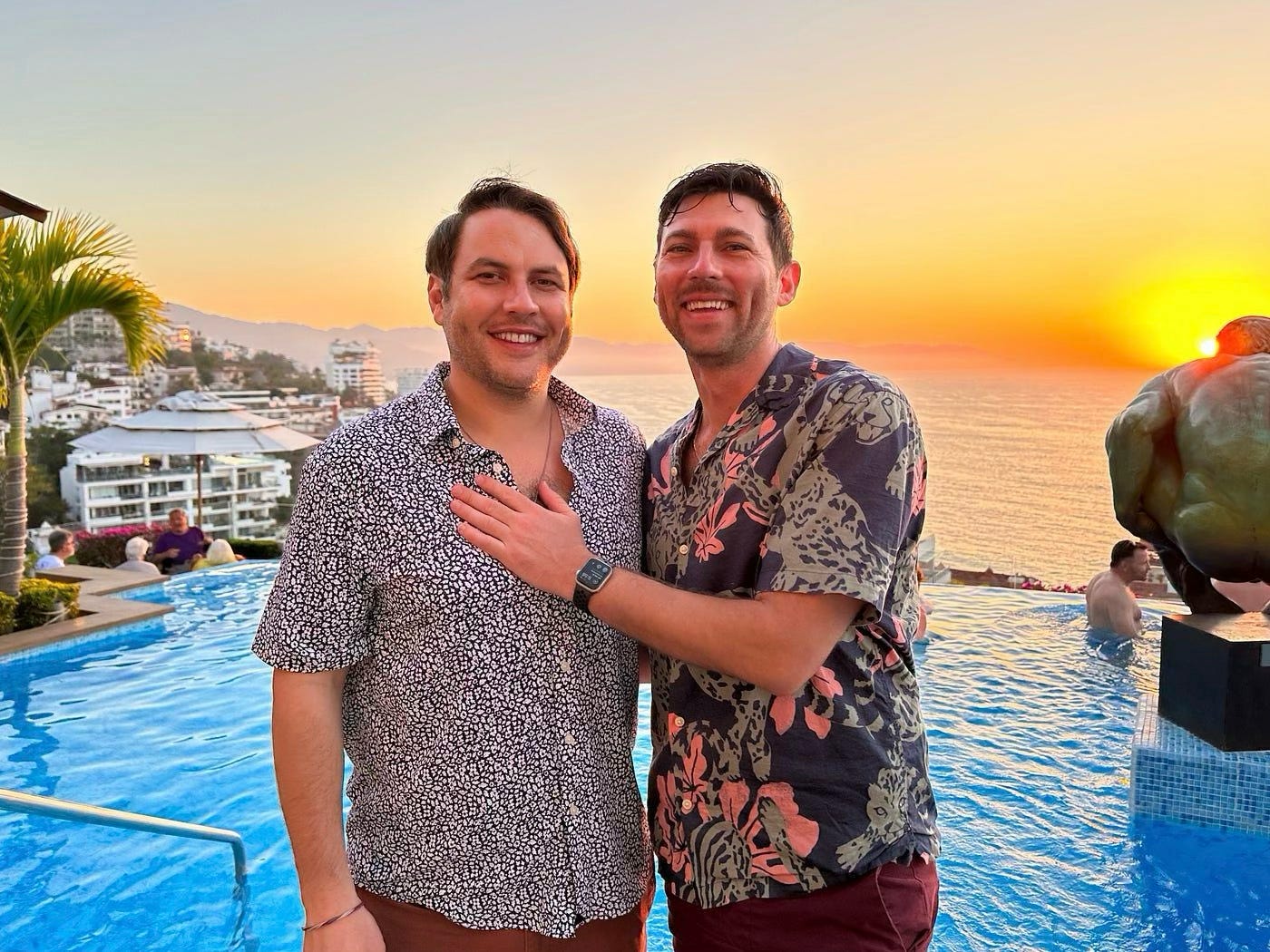
With Nate in Puerto Vallarta, Mexico in mid-February 2023. We went there together every February for years and loved our trips there. Looking back now, it feels surreal to no longer have Nate by my side. Sometimes, I still imagine him holding my heart like this, as I thought he would until it stopped beating.
Why I Stayed
“The mystery of love is greater than the mystery of death.”
— Oscar Wilde
People often ask why I kept trying. Why, after so many betrayals, lies, and disappearances, I still reached for Nate. Why I answered his calls, forgave his silences, believed his apologies, and left the door open long after he’d stopped walking through it.
The answer isn’t simple, but it is honest: because I loved him.
Not the man he became, but the man I had known — the man who once held me through grief, who danced with me until 4 a.m. at our best friend’s wedding in France, laughing beneath a canopy of fireworks bursting over the night sky. The man who spoke with fiery conviction about why I was the best candidate for my long-shot run for City Council, telling anyone who would listen that I could change the world. The man who pulled me out of the water when I panicked in the ocean, who steadied my breath until I could laugh again. The man who was my shoulder to cry on when my dad died, and again when our dogs died, and who, for nearly fifteen years, was there for me every single day — until he wasn’t.
For years, that love was a truth I could touch. It lived in our laughter, our travels, our quiet mornings at home. And when he began to unravel, I believed that love could bring him back. I thought if I stayed — if I just loved him harder — he would find his way out of the darkness.
But it wasn’t just love. It was trauma, too — the kind that binds you to someone even as they’re breaking you. There’s a word for it: trauma bonding. You begin to confuse the relief that follows pain for intimacy, the calm between crises for safety. Every time Nate left and returned, my nervous system flooded with hope — maybe this time he’ll stay, maybe this time it will be different. And when he didn’t, the absence hurt so much that I reached for the only thing that ever soothed it: him.
I also stayed because I saw his wounds. I knew about the childhood trauma, the conversion therapy, the abuse. I knew how early shame can metastasize into self-destruction. Part of me believed that if I could love him unconditionally, it might undo what had been done to him — that I could be the proof that love really could heal all things.
But love alone isn’t medicine — not when the person you love refuses treatment.
So I stayed, too, out of loyalty. Out of vows. Out of the belief that commitment means endurance, not surrender. I had promised “until my last breath and beyond,” and I meant it. The problem was, he didn’t. He was living in avoidance; I was living in devotion.
And finally, I stayed because leaving would have meant accepting that the man I married was gone. It’s one thing to lose someone to death; it’s another to lose them while they’re still alive — walking the same Earth, carrying the same name, but no longer reachable. I couldn’t bear that reality at first. So I kept trying, like tapping on glass, hoping the person on the other side might turn toward me one last time.
I didn’t stay because I was weak. I stayed because I was strong — because I believed in goodness, in redemption, in the sacredness of the life we built. And I stayed until I could no longer confuse hope with love, or love with harm.
In the end, I didn’t walk away because I stopped caring. I walked away because I finally understood that caring for him could not come at the cost of losing myself.
And so the years of trying became the years of relapsing — the cycle of holding on giving way to the slow, necessary work of letting go.
With Nate in Copenhagen, Denmark, circa 2012. Nate’s first high school love was from Denmark, and we enjoyed visiting him from time-to-time (he also came to our wedding).
What Do I Do
by Jared Milrad
What do I do
with my broken heart
when it doesn’t heal —
when the pain of losing you festers,
when I feel like I can’t breathe,
can’t walk,
can’t live another moment
without you?
What do I do
when the missing
becomes unbearable —
when the agony
of loving a version of you
from the past
becomes too painful
and too real?
I don’t know how to mourn.
I just want to be free of this,
so I can somehow
meet you again.
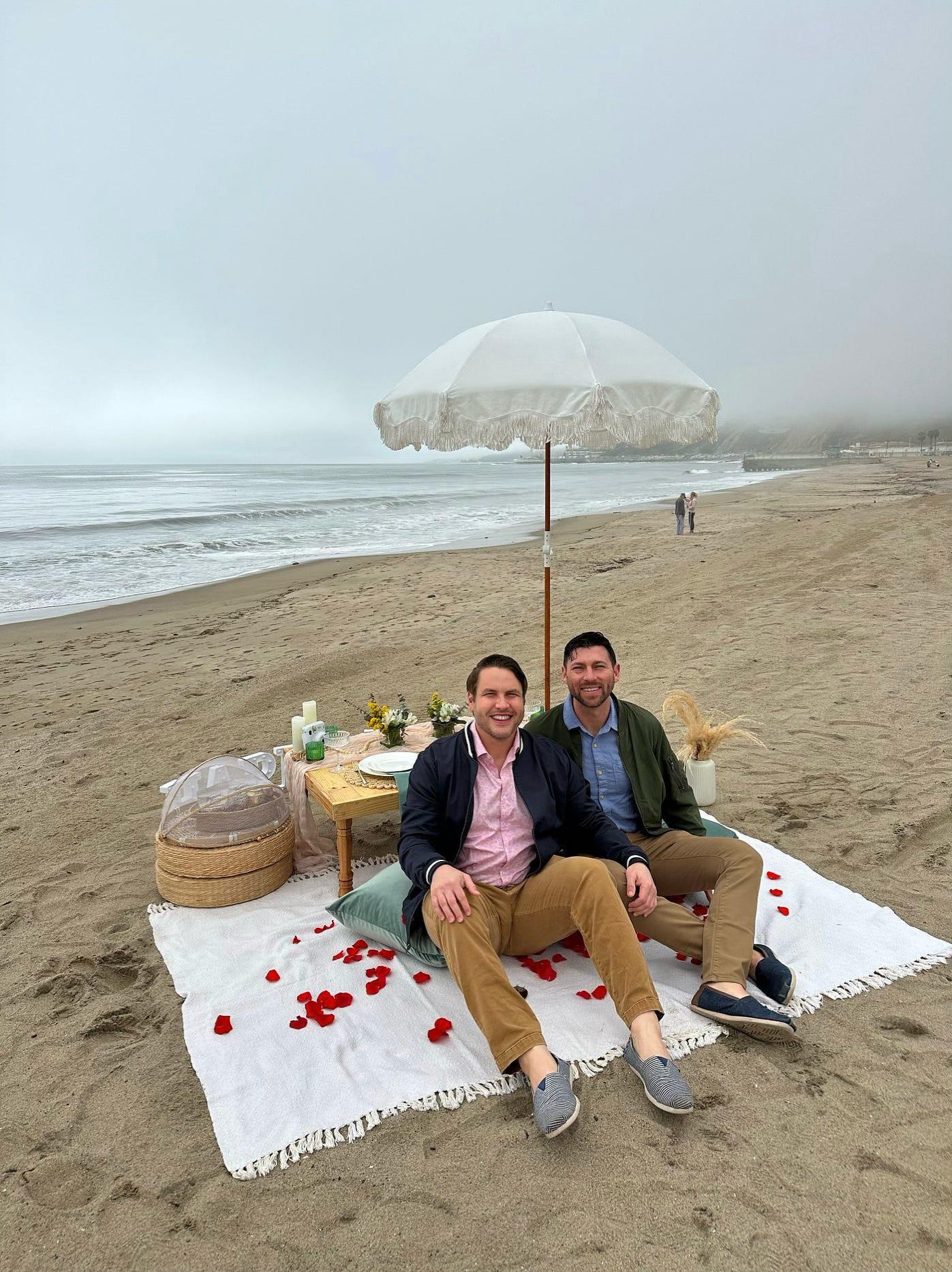
With Nate celebrating his 38th birthday in Santa Monica, CA, in March 2023. I had surprised my husband with a birthday picnic in one of our favorite spots. We shared snacks on the beach and talked about our hopes and dreams for each other — and for our marriage — and we laughed a lot. I never could have imagined what would happen just a few months later.
Epilogue: Love as Paperwork — and Letting Go
In October 2025, while in Washington, D.C. for work — just a mile from where Nate now said he lived, between more trips to Florida and beyond — I received the final notarized divorce papers. I’d sent several reminders for him to complete them, the last step before submitting our settlement to family court.
The week before, Nate had asked if I wanted to get dinner while in D.C. “After all,” he said, “I still want to be your friend.”
I told him I didn’t think so. I couldn’t condone, much less share space with, the ongoing lies, betrayals, and abandonments that had followed me like ghosts for years. He replied, half-joking, that he “wouldn’t be having sex or using drugs at dinner” — an odd thing to say, and painfully telling. Then, as usual, he disappeared. On my last night in D.C., he texted that he wanted to talk — and then ghosted again. Typical Nate in the years of his decline and decay.
My mom first told me not to see him. Then she softened, saying I should trust my feelings — that it would be okay if I did. Part of me wanted to. A bigger part didn’t. He was gone, in more ways than one, and had been for years. So I chose to honor his memory in my heart instead of facing the dark shadow he had become.
When I filed the final paperwork, I sat in my car outside the courthouse in Indio, California, crying and listening to Sufjan Stevens — the artist we’d once seen in concert together. His songs, Chicago and Mystery of Love, had scored so many moments of our life. As the music swelled, I texted Nate one last outpouring of emotion, telling him that I had given our marriage everything I had — and that I would always love him “until my last breath and beyond,” the vow I’d spoken on our wedding day.
He didn’t respond for three days. When I finally texted to ask if he was okay, he wrote back:
“I truly am sorry for the way I’ve treated you the past few months. I thought that I could make us work again, but I realized quickly that I have changed and couldn’t adhere to the boundaries we previously agreed upon.
You inhabit a part of my soul deep and profound. It’s been so hard to reconcile all of these intense feelings I have for you because I want to be there for you… It sometimes feels better to just move on, and other days it feels like I’m in someone else’s body. Maybe one day I’ll figure out what I want, but I know it’s not fair to you to drag you along a journey you didn’t sign up for.
I do not want to hurt you anymore, and I want only for you and your family to experience joy and happiness. I hope we can heal along the way as well.”
It felt like another vague approximation of the devastation he’d caused — and was still causing — without real accountability. And it was a profound understatement of the damage that Nate had inflicted over several years. Perhaps the only truth in his words was that he felt like he was “in someone else’s body” — which was exactly how it felt to love him in the end.
Days later, on the tenth anniversary of my father’s passing, Nate texted again. He said he was thinking of my dad and me, and how much my dad had loved me. It was a kind message, in a way, but also spectral — like a flicker from someone half-present, half-gone.
Shortly after, I texted him our wedding vows, the ones in which he had promised to “be with you until the very end, because you are my best friend, my soulmate, and my one true love.” He didn’t respond.
Walking through D.C. that week, I felt time collapse. It was a city that had shaped both of us. I had interned in the U.S. Senate after college, later worked in the White House during law school, and then for a nonprofit afterward. In 2009, the night before President Obama’s inauguration, I told Nate I loved him for the first time. And in late 2022, we stood together on the South Lawn of the White House watching President Joe Biden sign the Respect for Marriage Act into law, as the building glowed in rainbow light behind us.
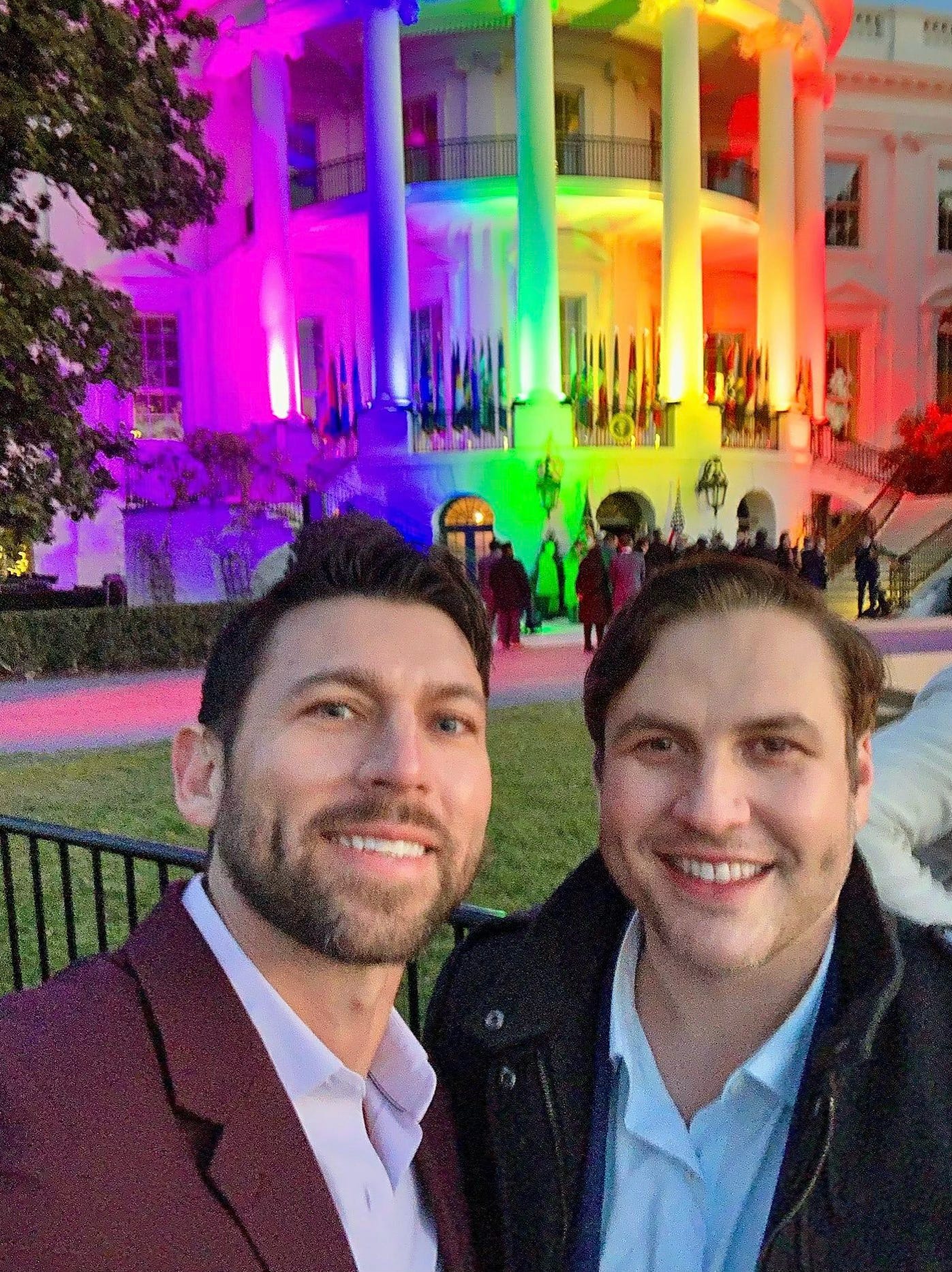
With Nate at the White House in December 2022 at the signing ceremony of the Respect for Marriage Act, which enshrined marriage equality into federal law. It felt like Pride at the White House, and after an exhausting redeye flight and early morning, we were overjoyed to be there. Ironically, Nate would secretly file for divorce a year later.
Now, years later, I walked those same D.C. streets alone — but this time, I wasn’t thinking entirely of Nate. I was thinking of my mom, who’d always stood by me, and of the person I was dating back home — someone with whom I was beginning to imagine a future.
As I passed the White House again, I felt grief and freedom standing side by side. I was ready to let go. Ready for a new chapter.
The irony wasn’t lost on me. Nate and I had always dreamed of having children one day — if we could afford it — and of creating a little “stinky farm,” a rescue sanctuary for dogs and animals. And yet, as our divorce finalized, I was the most financially stable I’d ever been — more than Nate, ironically. I was doing work I loved after years of struggle, and I closed on my first condo the very same day I filed the divorce papers. The person I was dating had two rescue dogs who had quickly become Dolly’s best friends, and together we shared the dream of starting a family one day — though I’ve learned not to plan much beyond tomorrow anymore.
Then, as the seventeenth anniversary of the night Nate and I met in November 2008 approached, I prepared to release my first EP — aptly titled The Shape of Missing. It’s the sound of grief becoming motion: of love, and what remains after; of the boy I was, and the man I am still becoming.
In late October, Nate and I spoke over FaceTime while I sat in the same Palm Springs park where Dolly used to chase her ball — the same place we’d once laughed together in simpler days. He seemed distant, detached, yet calm and reflective — part of the familiar cycle I had come to know too well. He admitted that he “self-medicates” and “tries to cope in unhealthy ways” instead of facing hard truths. He said he missed me. I said I missed him too. He told me he hadn’t shown his love the way I had shown mine, apologized for acting immaturely, and for causing me so much pain. He said he couldn’t be the kind of husband he had promised to be, or the man I deserved.
By that point, all of it was self-evident.
We agreed that what had unfolded was tragic — for both of us. He acknowledged that he needed real help to break the cycle he was trapped in, though whether he ever would remained uncertain. He asked about Dolly, said he was proud of me for releasing my music and becoming a homeowner.
Later, Nate said he had “no plans” to come back to Palm Springs — not that I really wanted him to anymore — and offered some matter-of-fact feedback about this very writing, saying that it was “very heartfelt.” He promised to send me edits — but, unsurprisingly, never did.
He then asked how he could retrieve his bike, which was still in a storage unit a mile from our former home. I was struck, as always, by how Nate could reduce a seventeen-year bond filled with countless shared memories down to one object. “It isn’t that simple,” he said, briefly emotional, adding that he “cherished” our memories and wanted to “help with Dolly someday.”
Indeed, that was Nate in 2025 — vague non-promises, avoidance, and deflection at all costs. A shell of the man he once was, he could shift seamlessly from asking about the dog he’d repeatedly abandoned, to commenting on the weather, to running from his own shadow.
As our conversation ended, I wished Nate a Happy Halloween. For a moment, I imagined us as children again — scared and hopeful, loving and lost, reaching for the light. And I was grateful, in that brief flicker, to glimpse the man I had loved so deeply — even if only for a moment — and for all the moments we’d shared over nearly two decades, never knowing how many more we would get.
As I’ve painfully learned from watching my dad’s beautiful mind fade as dementia ravaged it, moments are all we ever have in this life.
That day, as I walked home to hug Dolly, I thought of the short film Nate and I had made together years earlier, Marriage, and the book we co-wrote after our wedding, So, You Want to Get (Gay) Married? We used to laugh about writing a guide to getting divorced one day. Sadly, that laughter was now a painful reality.
And then I realized: many of the dreams Nate and I once shared might still come true — just without him.
In the end, perhaps my seventeen-year relationship with Nate had been preparing me for what came next — not in the form I once imagined, but meaningful nonetheless.
With Nate at an event for the nonprofit that I started in Chicago in 2014. During our many years together, I organized more events and entrepreneurial forays than I can count. And Nate was always there by my side — until he wasn’t.
The Love You Left Behind
by Jared Milrad
I was never cruel
to be cruel.
Even when your silence
stretched thin as glass,
even when I pleaded
like a tired man
on trial
for crimes he did
not commit,
even when you left
while I stayed
searching.
I laid out my grief
like clean linens,
and folded the ache
so you wouldn’t fall on it.
I made room
for your doubts,
and set a place at our table
for your ghosts.
And still,
you could not look at me
without seeing
a haunted past
that was never mine.
So now,
I carry this quiet knowing —
that no matter how gently
I held the mirror,
you would not stay
to see yourself.
You needed me
to close the door
so you could call yourself
a man
strong enough
to stand alone
in a home built for two.
But I will not play
the villain
in the leading role
you wrote
for those
who hurt you first.
I loved you
even in the unraveling.
When you asked for stars,
I gave you the galaxy.
When you asked for space,
I gave you the universe.
So if you leave,
know that you left
your other half
still reaching
for the missing part
of his open heart —
who dared
to try
to love
the love
you left behind.
With Nate in July 2009, just a few months after we met. I quickly loved him more than anything in the universe.
The Growing Up
Nate and I used to joke with friends that after a decade of marriage, we would decide whether to “re-up” for another ten years. Clearly — and sadly — that was no longer possible.
I mourn our marriage. But I also honor it. The inscription inside our rings — eternal sunshine — promised a permanence that life could not keep. Yet the love was real. The places we traveled, the dogs we rescued, the laughter, the nights we held each other and cried, the small domestic mercies — all of it was true. I’ll carry those truths forward: into this new relationship I’m building, into the family I hope to have, into whatever comes next.
I still miss Nate, and probably always will. While I cannot change the timeline I live in, I can grieve how it turned out. As my mom told me recently, I will always love him in some way, and I may forever wish that our path had unfolded differently. She also said something else that I’ve held close: that I was very brave to share my experience with the world — not to diminish anyone else, but to finally tell the truth I carried alone for too long.
Early in our relationship, Nate and I visited Provincetown, Massachusetts, with our dog, Cooper, during those perfect Cape Cod summers. One night, we walked beneath the stars along the beach, talking about our hopes and dreams — who we wanted to become, what we wanted to build, the kind of lives we imagined together. Nate said then that I was focused on my magnum opus — a singular, great work that would define my legacy. Years later, I realized that perhaps he — that we — were my magnum opus. Because even though it ended in heartbreak, it was, at its best, a true testament to what love can be.
Love cannot heal all wounds. But it can make us stronger, wiser, and more resilient.
I don’t know when — or if — I’ll see Nate again, or if he’ll ever see Dolly again, the blonde furball he rescued one summer afternoon in Long Beach. And I don’t know if he and I will — or can — reconcile in any meaningful way.
Yet I do know that I’ll think of Nate, as I vowed on my wedding day, until my last breath and beyond.
For now, I see him in the way the afternoon light moves across the mountains, in how gently the moon rises and falls, and in the effortless flight of the red-tailed hawk over the desert below. I miss him — sometimes unbearably, and other times with the peace that only letting go can bring.
On our wedding day in 2015, Nate described our bond as “metaphysical.” I still believe that’s true. And while he may no longer walk beside me in this life, the best of him does — the part that once cheered me on, that stood beside me, that offered strength, courage, and wisdom through all of life’s unexpected turns.
Indeed, nothing is forever. And yet: I grieve. I remember. I celebrate. And I keep going — because the memories of yesterday and the hope for tomorrow are all I have left.
On a Friday night in November 2008, in Boston, two young men started a life together.
And, as James Baldwin wrote:
Love is a battle, love is a war — love is, for sure, a growing up.
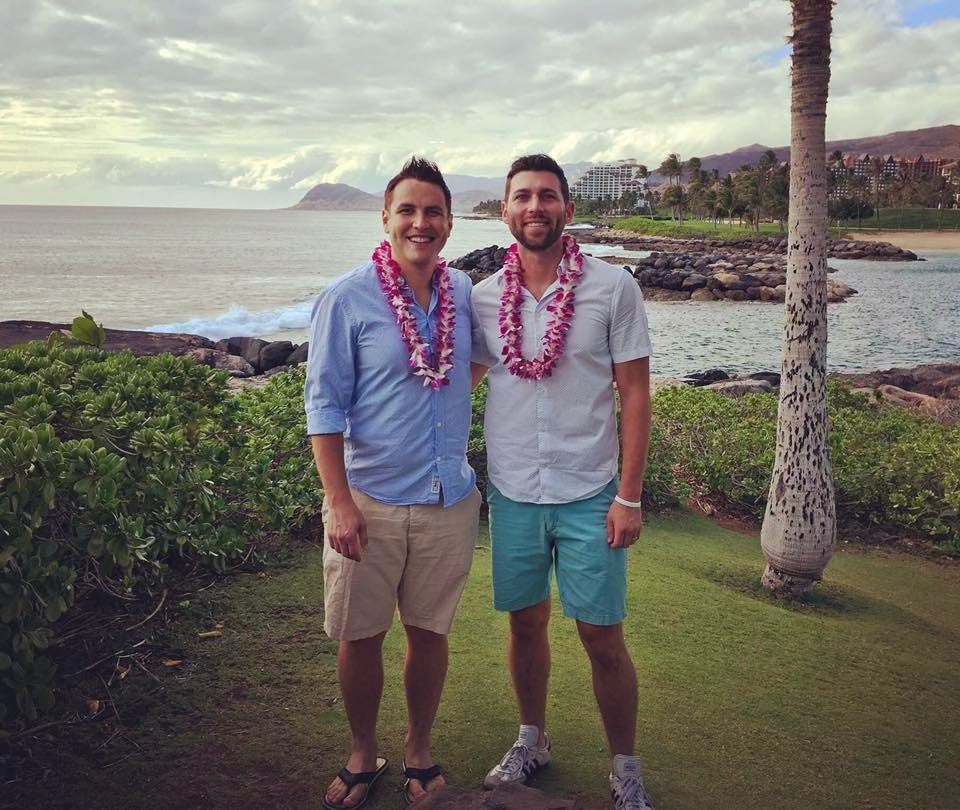
Renewing our vows together during our honeymoon in Oahu, Hawaii in 2016. On a trip to Hawaii just a few months after our wedding, my husband surprised me by bringing me to a vows renewal ceremony. Most of the other married couples had been married years or decades, but renewing our vows this soon after our marriage made me feel even more deeply in love with my husband. And it was such a thoughtful thing for him to do.
Postscript: After the Music
In late November 2025 — just hours after the release of my EP, The Shape of Missing, a body of work about love, grief, and the life Nate and I once shared — I walked outside my home in Palm Springs near midnight and found the Chevy Equinox totaled on the sidewalk in front of the house we had once lived in together. A drunk driver had smashed into it, leaving the car in pieces, glass and metal scattered across the street.
I remember standing there in the dark, stunned, thinking how precisely it mirrored the last years of my marriage: sudden, violent, senseless, and irreversible.
When I told Nate what had happened, his response was brief and distant.
“Glad you and Dolly are okay.”
Nothing more.
Months later, in January 2026, we spoke again. During that call, Nate told me he was “in a relationship.” When I asked if it was with Brian — the man with whom he had carried on a years-long betrayal of our marriage — he hesitated before finally saying yes. Then he began to cry. Whether from shame, grief, or the collapse of the stories he’d told himself, I don’t know. I only know that by then, the truth had long since stopped being shocking.
I reminded him — calmly — that continuing a relationship born of secrecy and betrayal was still a profound violation, and one that had caused lasting trauma. He said he “didn’t want to talk about the past.” He said he “couldn’t control his feelings.” He said he wanted us to have weekly check-ins, and that he had decided to be sober “for a few months” because I had encouraged him to be.
It sounded like what I had heard so many times before: insight without accountability, intention without action, remorse without repair.
By then, I no longer needed an explanation. The pattern had explained itself.
There is a particular grief that comes from realizing that the person you loved is not only gone, but has chosen not to return — not to you, not to themselves. That grief doesn’t arrive all at once. It comes in waves, often quietly, often long after the damage is done.
And yet, even here, there is clarity.
I survived loving him.
I survived losing him.
And I survived telling the truth.
What remains is not bitterness, but knowledge: that love can be real, deep, and enduring — and still not survive the weight of avoidance, addiction, and repeated betrayal.
I no longer wait for the man Nate used to be to come back. I carry him with me instead — as memory, as lesson, as proof that I once loved with my whole heart, and that doing so was never a mistake.
Some endings are not explosions.
They are quiet recognitions.
And sometimes, letting go is not an act of anger —
but of mercy.
A few weeks later, on a trip to Kauai in November 2025, after this essay had already been shared with the world, my partner and I visited the Kauai Humane Society. There, we met a young Corgi mix — bright-eyed, gentle, uncertain. We decided to bring him home and named him Liko, a Hawaiian word meaning “new beginning.”
It wasn’t a declaration, or a turning point, or a cure. It was simply an act of care — the kind that asks nothing back. And in that small, quiet choice, I felt something return to me that I thought I had lost: not certainty, but steadiness. Not closure, but life.
Author’s Note
From 2023–2025, writing — especially poetry — was often the only thing that kept me going. I published two collections in those years: If Only You Had Stayed (2024) and The Love You Left Behind (2025). Music also helped me survive: I published my first single, The Shape of Missing You, in October 2025, followed by my EP, The Shape of Missing, in November 2025.
I’m grateful to the numerous friends, clinicians, and kind strangers who helped me keep breathing — and who spent countless hours with me, helping me heal, grow, and survive.
I also owe a profound debt of gratitude to the selfless volunteers at The Trevor Project and the 988 Suicide and Crisis Lifeline, which I called over 100 times between 2023–2025 during times of true despair, fear, and panic. And I am forever indebted to the therapists, colleagues and family members who gave me a glimmer of hope when I felt hopeless.
Lastly, to the man I loved and lost, to Cooper and Oliver who will always be close to my heart, and to Dolly who was there for me on the darkest of days — I thank you, and you will always be in my soul.
I dedicate this writing to my mother, Jan, and to the memory of my father, Martin, who I miss everyday.
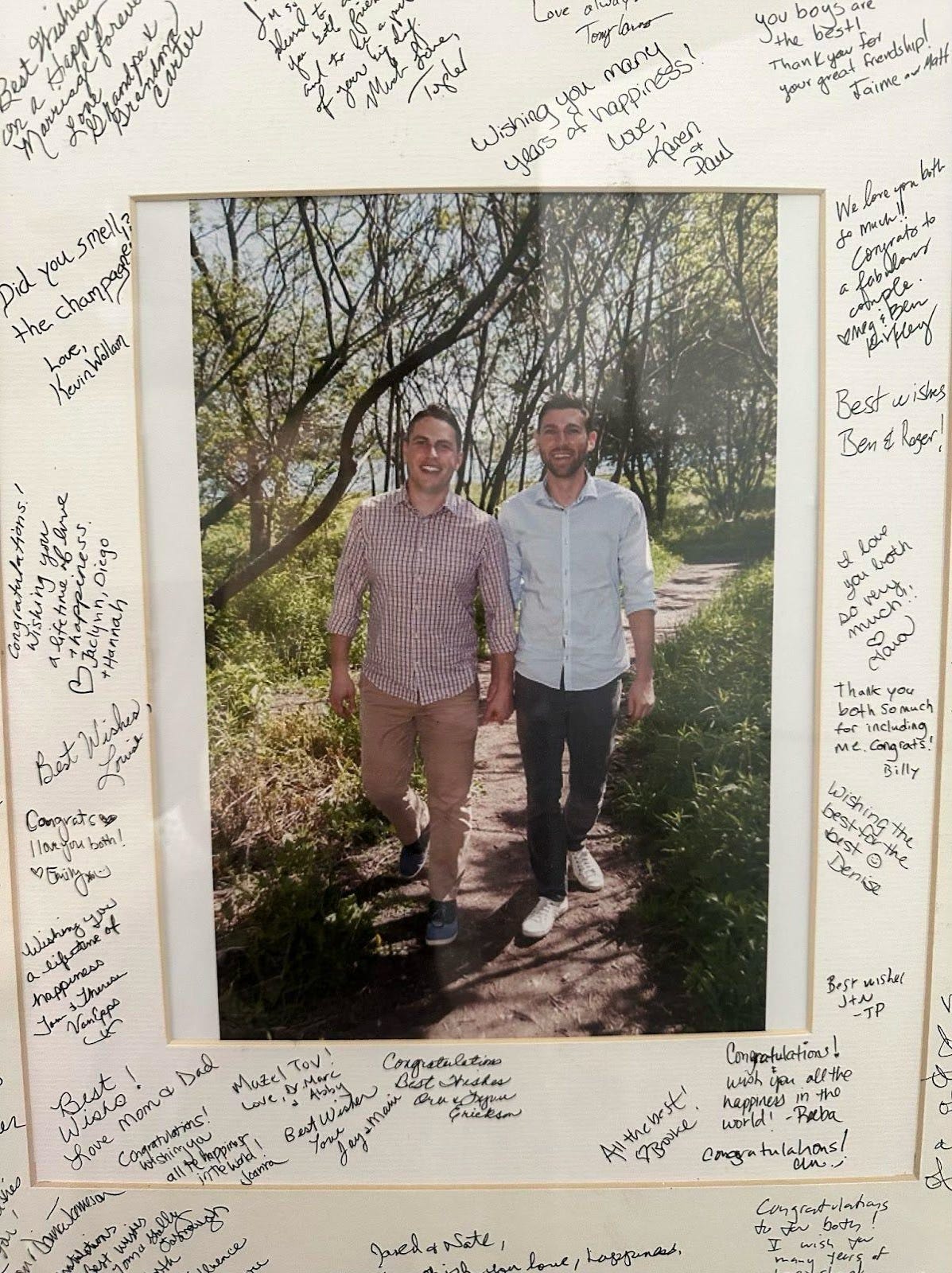
A pre-wedding photo of Nate and I in Chicago, IL, taken just a few months before our wedding on July 19, 2015. During our wedding reception, we asked our guests to leave any notes that they wished to. When Nate repeatedly left our home in Fall 2023, he left this framed photo behind, and I saw it everyday near our bed, making his absence that much more painful. I took it down because it was too unbearable to see everyday, but I hope to have it with me for the rest of my life — even if Nate isn’t with me as he always had been.
Disclaimer
This essay reflects my personal experiences, perceptions, and memories over many years. Certain names, identifying details, and events are included as they occurred to the best of my recollection, but others may reflect the natural subjectivity of lived experience. This piece is offered as personal narrative and creative nonfiction.
While this writing includes real people and events, my intent is not to harm, accuse, or assign motives to anyone. Instead, I am sharing my own truth — how these experiences felt to me, how I made sense of them, and how I lived through them. Writing this has been an act of healing, meaning-making, and reclamation: a way to honor love, confront grief, and transform pain into clarity. Any interpretation beyond my own lived perspective is neither implied nor intended.
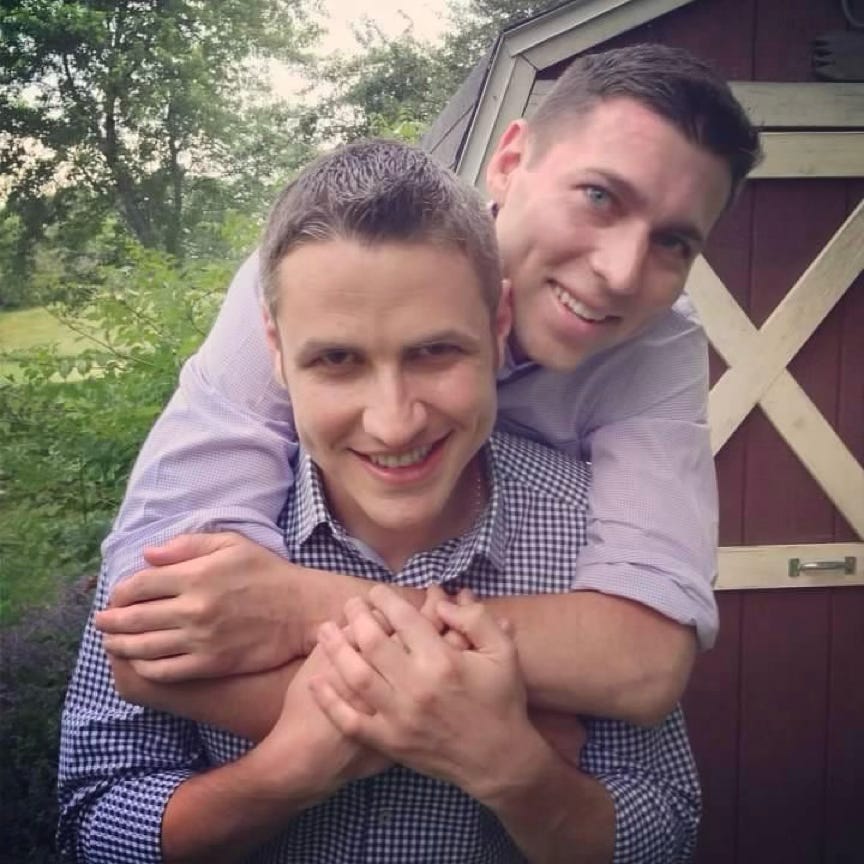
With Nate in the backyard of his childhood home in central Michigan, just a few years before our wedding. I’ll always remember him this way — holding me tightly through all of life’s many ups and downs. Until my last breath and beyond, I’ll miss him everyday.
This essay sits alongside my poetry collection, The Love You Left Behind, and my EP, The Shape of Missing., which explore grief, memory, and survival through art.
Jared a lovely very poignant piece of writing,your own personal story.
It’s amazing the lengths we go to for love… Yet I understand completely. I wish Ye all the very best of happiness and health. Take Care. Ye deserve so much more, as does Nate. I hope Ye both find it. x